
- The Apple iPhone 18 Pro, Samsung Galaxy S26 Ultra and OPPO Find X10 Pro Max are the strongest all-round smartphones on sale in Australia in 2026.
- Australia's 3G networks have closed, and telcos must block phones that cannot make triple zero (000) calls over 4G.
- The Regulatory Compliance Mark (RCM) shows a phone meets Australian standards, and the ACMA warns that phones bought online from overseas may not work on local networks.
- Australian versions of the iPhone 18 Pro and Pixel 11 Pro take a physical nano-SIM as well as eSIM, unlike the eSIM-only US models.
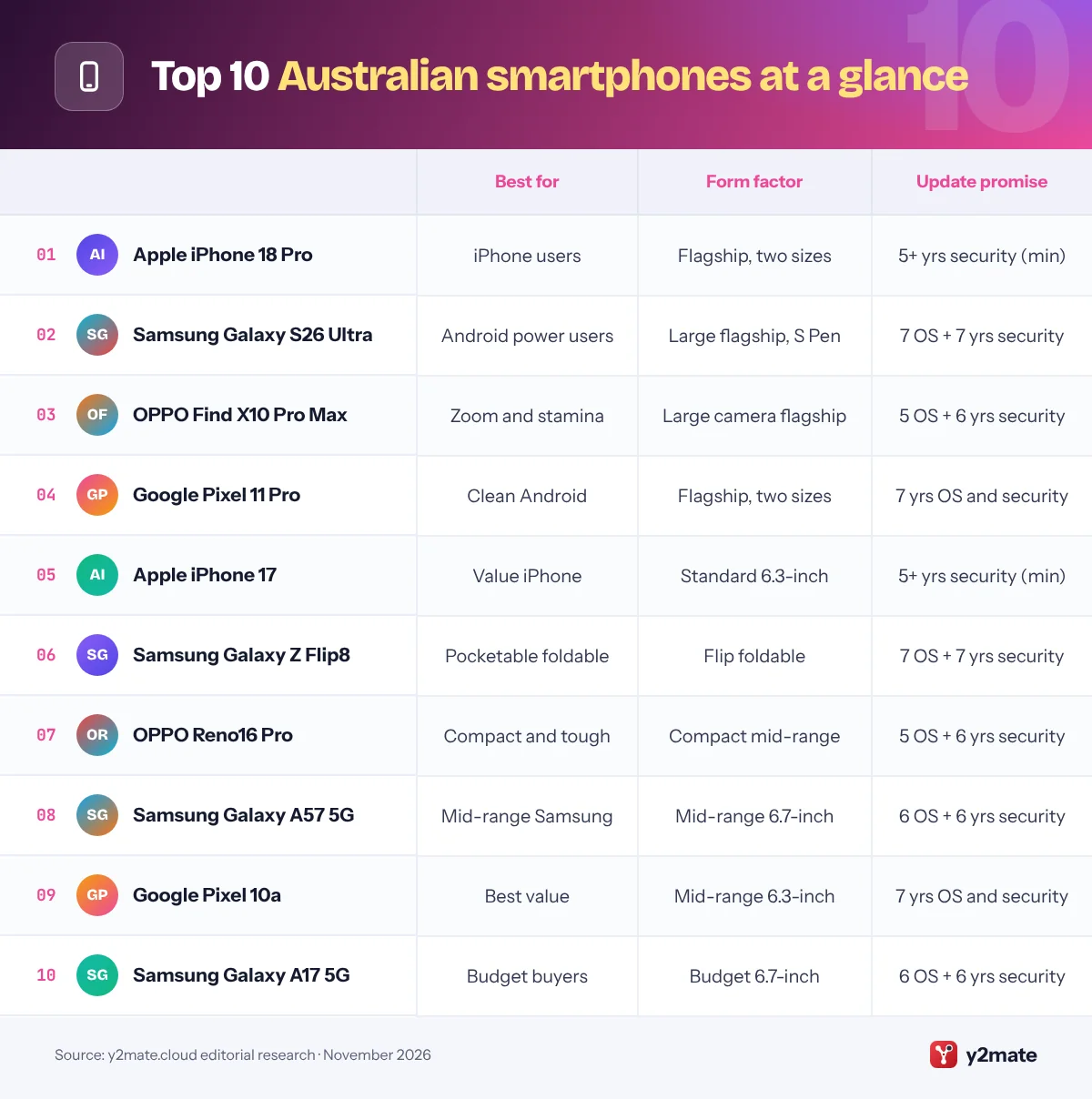
- Samsung and Google promise six to seven years of updates on the phones in this list, while OPPO promises five OS upgrades and six years of security updates.
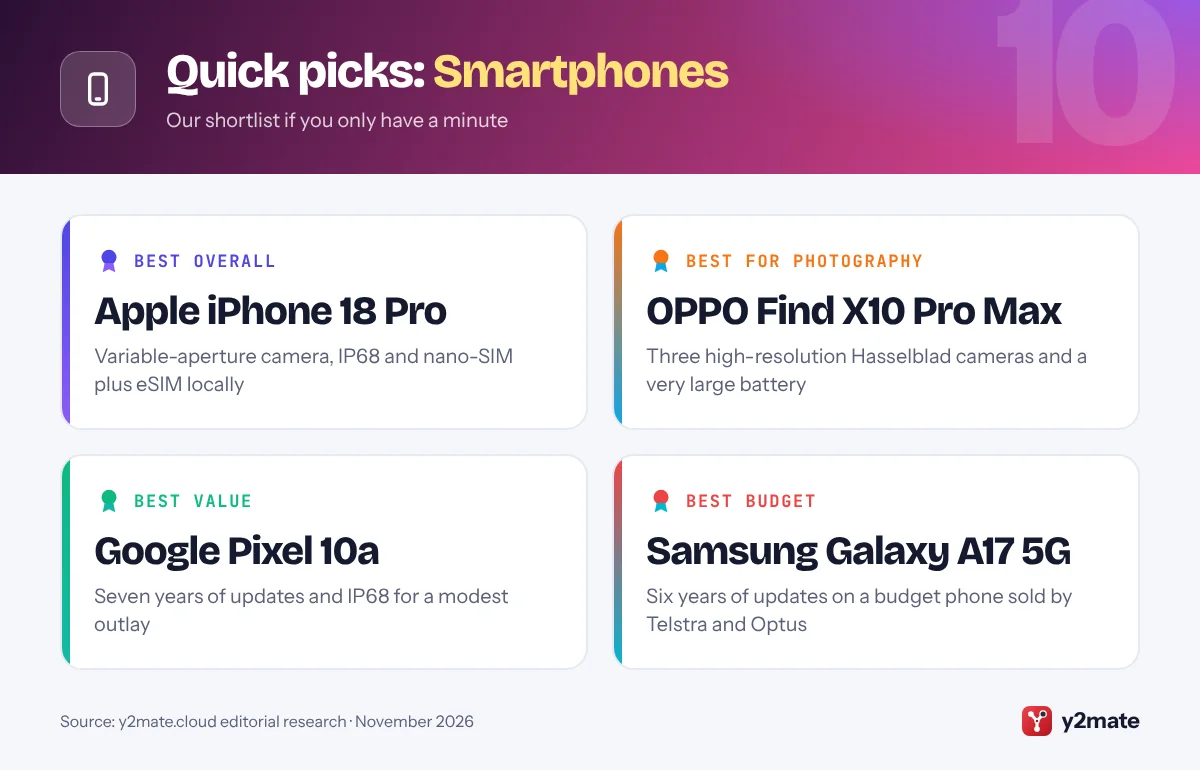
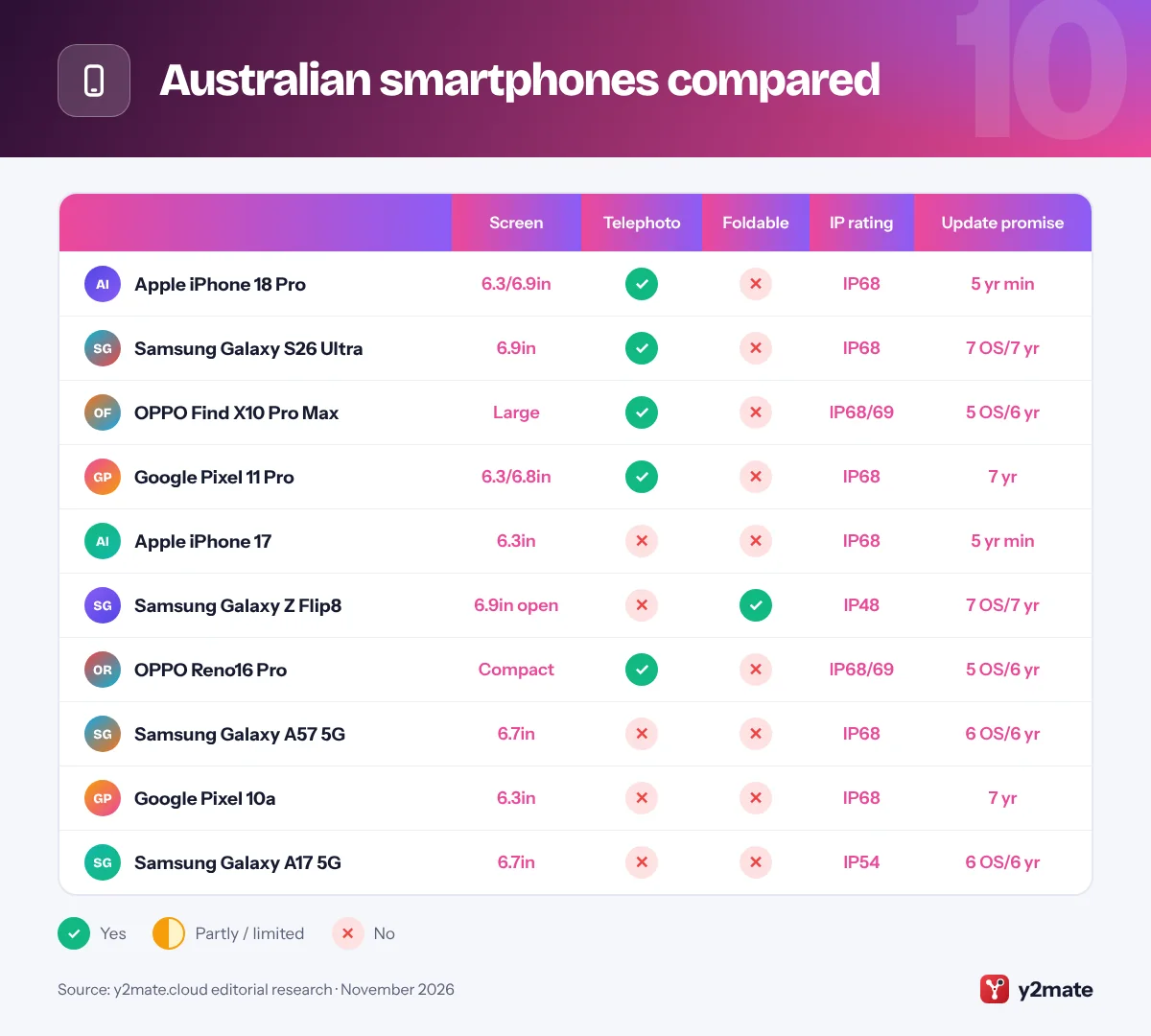
The best smartphones in Australia in 2026 are the Apple iPhone 18 Pro for iPhone users, the Samsung Galaxy S26 Ultra for Android power users and the OPPO Find X10 Pro Max for camera lovers who want long battery life. The Google Pixel 11 Pro, iPhone 17, Galaxy Z Flip8, OPPO Reno16 Pro, Galaxy A57 5G, Pixel 10a and Galaxy A17 5G complete the list, covering foldable, compact, mid-range and budget picks that are all sold through Australian stores and telcos.
Australia has its own rules for phones. Since the 3G networks closed, a phone must support VoLTE, or voice calling over 4G, including for triple zero (000) calls, and telcos must block phones that cannot reach 000 over 4G. Bands are the radio frequencies a network uses, and Telstra and Optus rely on low-band 700 MHz spectrum, known as band 28, for much of their regional 4G coverage. The RCM, or Regulatory Compliance Mark, shows a phone meets Australian standards, while a grey import is a phone brought in outside the maker’s official local channel. An update policy is the maker’s promise of how long it will deliver new software versions and security fixes.
This guide ranks ten phones on those practical points and explains what to check before you buy.
How we ranked this list
We compared publicly documented information only: each maker’s official software-update commitment, whether the phone is sold officially in Australia through the maker, major retailers or telcos, size and form factor, the camera system and battery as the maker describes them, and durability ratings such as IP68. We confirmed that each model is sold officially in Australia.
We did not test the phones ourselves and do not quote prices, speed test results or battery figures. Every pick is an Australian model sold locally, so it should carry the RCM and support local 4G calling, but always confirm with your telco before switching.
The Top 10 Smartphones
1. Apple iPhone 18 Pro
Best for: iPhone users who want the best camera
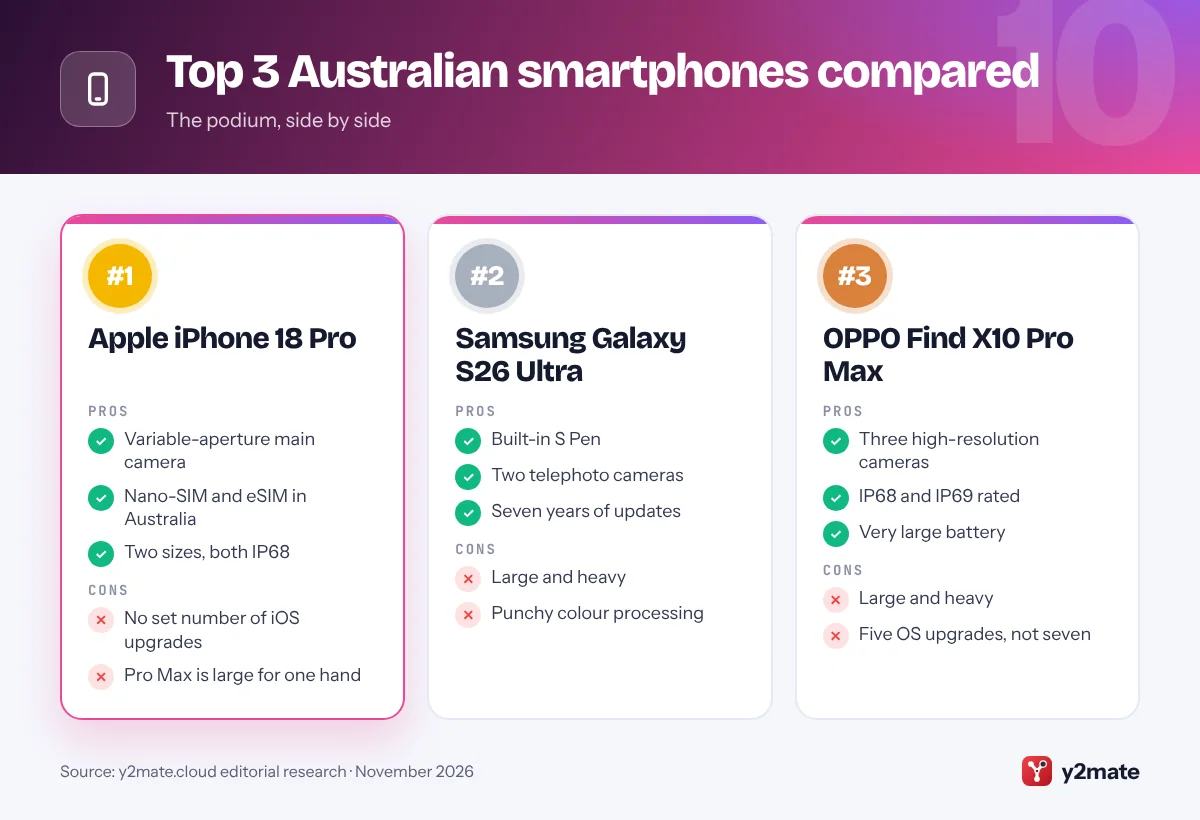
The iPhone 18 Pro and the larger iPhone 18 Pro Max, released in Australia in September 2026, are the best phones here for anyone already invested in Apple’s ecosystem. The main camera now has a variable aperture, which physically adjusts how much light reaches the sensor, and the Camera app adds manual Pro controls for aperture, shutter speed and white balance.
Australian models keep a nano-SIM slot as well as eSIM, unlike the eSIM-only US versions, so moving your existing SIM across is simple. Both sizes are rated IP68, run Apple’s new A20 Pro chip and use Apple’s own C2 modem. Because they are sold locally, they are set up for 4G calling on Telstra, Optus and Vodafone, including triple zero calls.
Apple does not promise a fixed number of iOS upgrades, but it has committed to a minimum of five years of security updates from first supply in its UK compliance filings, and older iPhones have usually been supported for longer. Buying outright from Apple or a retailer and adding a SIM-only plan gives you the most flexibility. For iPhone users who want the best camera and battery, this is the one to buy.
Official site: Apple iPhone 18 Pro
- Variable-aperture main camera
- Nano-SIM and eSIM in Australia
- Two sizes, both IP68
- No set number of iOS upgrades
- Pro Max is large for one hand
2. Samsung Galaxy S26 Ultra
Best for: Android power users who want a stylus
The Galaxy S26 Ultra is the most complete Android phone sold in Australia. Its 6.9-inch screen has a built-in S Pen for handwritten notes and precise editing, and it is the only S26 model with Samsung’s Privacy Display, which hides the screen from people beside you on the bus or train. The camera system combines a high-resolution main camera with an ultrawide and two telephoto cameras, giving flexible zoom for sport, travel and wildlife.
Samsung promises seven generations of Android OS upgrades and seven years of security updates. The phone is rated IP68 and uses Qualcomm’s Snapdragon 8 Elite Gen 5 for Galaxy chip.
It is sold outright by Samsung and major retailers, and on plans from Telstra, Optus and Vodafone, often with long device repayment terms. If you take one on a plan, check what happens to any bonus credits if you leave early. It is large and heavy, and Samsung’s processing leans towards bright, punchy colour. For anyone who wants one device for work, notes and zoom photography, the S26 Ultra is the strongest Android choice in Australia.
Official site: Samsung Galaxy S26 Ultra
- Built-in S Pen
- Two telephoto cameras
- Seven years of updates
- Large and heavy
- Punchy colour processing
3. OPPO Find X10 Pro Max
Best for: zoom photography and long battery life
The OPPO Find X10 Pro Max went on sale in Australia in late October 2026 and is the most ambitious camera phone you can buy locally. Its Hasselblad-branded camera system uses three high-resolution rear cameras, including a telephoto that can also focus close for detailed macro shots, and OPPO offers a teleconverter accessory for even longer reach.
It is rated IP66, IP68 and IP69, which covers dust, immersion and high-pressure water jets, and it has a very large battery that suits long days on the road. It runs ColorOS 17, based on Android 17, and OPPO promises five major OS upgrades and six years of security patches.
OPPO has a long-standing presence in Australia, and the Find X10 series is sold through OPPO’s online store and major retailers such as JB Hi-Fi, Officeworks, The Good Guys and Big W, so local support and warranty are straightforward. The standard Find X10 is a smaller alternative. The trade-offs are size and weight, and shorter support than Samsung or Google. For keen photographers who want the most zoom and stamina, it is the standout Android pick in Australia.
Official site: OPPO Find X10 Pro Max
- Three high-resolution cameras
- IP68 and IP69 rated
- Very large battery
- Large and heavy
- Five OS upgrades, not seven
4. Google Pixel 11 Pro
Best for: clean Android and seven years of updates
The Pixel 11 Pro, released in August 2026 alongside the larger Pixel 11 Pro XL, is the best choice for Australians who want Android as Google designs it. It runs Google’s Tensor G6 chip with a Titan M3 security chip, and Google promises seven years of OS, security and Pixel Drop updates, so it should stay supported into the 2030s.
The camera system includes a telephoto camera with optical image stabilisation, and Google’s processing is known for natural colour and reliable night shots. Both Pro models are rated IP68, use Gorilla Glass Victus 2 front and back, and have built-in Pixelsnap magnets for Qi2 accessories.
Australian models keep a physical SIM slot alongside eSIM, unlike the eSIM-only US versions. Pixels are sold through the Google Store, major retailers and telcos, so local warranty and network support are simple. Regular Pixel Drops add features during the year rather than waiting for a big annual release. If you value uncluttered software and dependable point-and-shoot photos, the Pixel 11 Pro is the Android phone to beat.
Official site: Google Pixel 11 Pro
- Seven years of updates
- Natural photo processing
- Pixelsnap magnets built in
- No stylus option
- Pro XL needed for a big screen
5. Apple iPhone 17
Best for: an affordable modern iPhone
The iPhone 17 is the best-value iPhone in Australia for most people. It has a 6.3-inch display with a smooth, high refresh rate, the A19 chip, main and ultrawide rear cameras, and a Center Stage front camera that can take landscape and group selfies while you hold the phone upright. It is rated IP68, supports MagSafe accessories and includes the Action button and Camera Control.
Compared with the iPhone 18 Pro you give up the telephoto camera, the variable aperture and some battery life, but for everyday photos, messages and video calls the difference is small. Australian models take a nano-SIM as well as eSIM.
It receives yearly iOS upgrades for as long as Apple supports it, with a stated minimum of five years of security updates. Because it is sold by Apple, major retailers and every big telco, it is easy to buy outright or on a plan, but compare the total cost of a long repayment plan with buying outright and adding a cheaper SIM-only plan from any provider. If you want a modern iPhone without Pro extras, start here.
Official site: Apple iPhone 17
- Smooth 6.3-inch display
- Center Stage front camera
- Nano-SIM and eSIM
- No telephoto camera
- Less battery than the 18 Pro
6. Samsung Galaxy Z Flip8
Best for: a pocket-sized foldable with long support
The Galaxy Z Flip8, announced in July 2026, is the best flip phone sold in Australia. Open, it has a 6.9-inch main screen; closed, it folds into a compact square with a 4.1-inch FlexWindow cover screen that can run apps, show notifications and frame selfies with the main cameras.
It is slim and light for a foldable, and Samsung gives it the same promise as its other 2026 flagships: seven generations of Android OS upgrades and seven years of security updates, far longer than most flip phones. The rear camera system pairs a main camera with an ultrawide but has no telephoto lens.
The Flip8 is rated IP48, which covers immersion in fresh water under test conditions but offers only limited dust protection, so keep it away from beach sand and red dust on outback trips. Motorola’s razr 70 Ultra is the main flip alternative in Australia, but Motorola’s software commitment is much shorter. If you want a phone that disappears into a small pocket without giving up long software support, the Flip8 is the foldable to buy.
Official site: Samsung Galaxy Z Flip8
- Pocketable when folded
- 4.1-inch FlexWindow
- Seven years of updates
- No telephoto lens
- IP48, limited dust protection
7. OPPO Reno16 Pro
Best for: a compact, tough phone for creators
The OPPO Reno16 Pro, launched in Australia in July 2026, is one of the few genuinely compact Android phones on sale here, with a display small enough for comfortable one-handed use. OPPO aims it at content creators, with a high-resolution main camera, a periscope telephoto camera and a high-resolution selfie camera for video calls and vlogging.
It is rated IP68 and IP69, so it copes with rain, dust, immersion and high-pressure water jets better than most mid-range phones, and it has a large battery with fast wired charging. OPPO has committed to five major OS upgrades and six years of security updates for the Reno16 series.
The compromises are no wireless charging and a slower USB 2.0 port for moving video files to a computer. It is sold through JB Hi-Fi, Officeworks, Harvey Norman and OPPO’s online store, and a cheaper Reno16 F sits below it. If you want a small, durable phone that shoots good video and will be supported for years, the Reno16 Pro is a smart Australian pick that you will not find in US stores.
Official site: OPPO Reno16 Pro
- Compact one-handed size
- IP68 and IP69 rated
- Periscope telephoto
- No wireless charging
- Slow USB 2.0 port
8. Samsung Galaxy A57 5G
Best for: mid-range buyers who want long support
The Galaxy A57 5G, on sale in Australia since April 2026, is the best mid-range phone for buyers who want Samsung’s software and long support without flagship prices. It has a 6.7-inch AMOLED display, an IP68 rating, and Samsung’s promise of six generations of Android OS upgrades and six years of security updates, keeping it supported into the 2030s.
It is sold outright by Samsung and major retailers and through telcos, so local stock, warranty and network support are easy to find. Its cameras handle everyday shots well, but there is no telephoto lens, and its chip sits below the Galaxy S26 range, so demanding games feel less smooth.
Samsung’s Knox security platform and familiar One UI software make it an easy step for anyone moving from an older Galaxy, including owners of phones that stopped working after the 3G shutdown. Cases and accessories are widely stocked too. If you want a dependable, water-resistant phone that will be supported for six years, the A57 is the sensible middle ground in Australia.
Official site: Samsung Galaxy A57 5G
- IP68 water resistance
- Six years of updates
- Large 6.7-inch AMOLED
- No telephoto lens
- Slower than flagships
9. Google Pixel 10a
Best for: the longest support for the least money
The Pixel 10a, on shelves in Australia since March 2026, is the best value phone here because it pairs a modest price with the same seven-year promise of OS, security and Pixel Drop updates as Google’s flagships. That makes it ideal for students, a teenager’s first smartphone or anyone who keeps a phone for many years.
It has a 6.3-inch display, an IP68 rating and a flat, simple design. The main and ultrawide cameras benefit from Google’s photo processing, including Night Sight for low light, though there is no telephoto lens, so zoomed shots are softer than on the Pixel 11 Pro.
It is widely sold through the Google Store and retailers such as JB Hi-Fi, Harvey Norman, Officeworks and The Good Guys, as well as Telstra, so you can easily buy a local model with Australian warranty and network support. Pair it with a prepaid or SIM-only plan for one of the lowest-cost ways to own a well-supported phone. If you want a dependable Android phone that will stay secure for years, the Pixel 10a is the easiest recommendation.
Official site: Google Pixel 10a
- Seven years of updates
- IP68 at a low price
- Simple, clean software
- No telephoto lens
- Not the newest Tensor chip
10. Samsung Galaxy A17 5G
Best for: a budget phone with six years of updates
The Galaxy A17 5G is the best budget phone in Australia for buyers who want a known brand and long support. Samsung promises six generations of Android OS upgrades and six years of security updates from its first global launch, which is rare at this end of the market and far longer than many budget phones offer.
It has a large 6.7-inch display, a triple rear camera with optical image stabilisation for steadier shots, and Samsung’s Theft Protection, which can lock the phone remotely if it is stolen. It is sold by Samsung, major retailers and telcos including Telstra and Optus, often on prepaid or long repayment plans.
The compromises are an IP54 rating, which protects against splashes and rain but not immersion, a basic chip that feels slower in demanding apps, and no telephoto lens. If you are replacing an older phone that no longer works after the 3G shutdown, or buying for a child or an older relative, the A17 5G is a dependable, well-supported choice that will keep getting security fixes into the 2030s.
Official site: Samsung Galaxy A17 5G
- Six years of updates
- Large 6.7-inch display
- Optical image stabilisation
- IP54, splash-resistant only
- Basic chip
Australian smartphones compared
How to choose between smartphones in Australia
Start with how you will pay. Telstra and Optus offer phones on long repayment plans, often over 36 months, alongside a mobile plan, which spreads the cost but can tie you in. Buying outright from the maker or a retailer and adding a prepaid or SIM-only plan from any provider keeps you flexible.
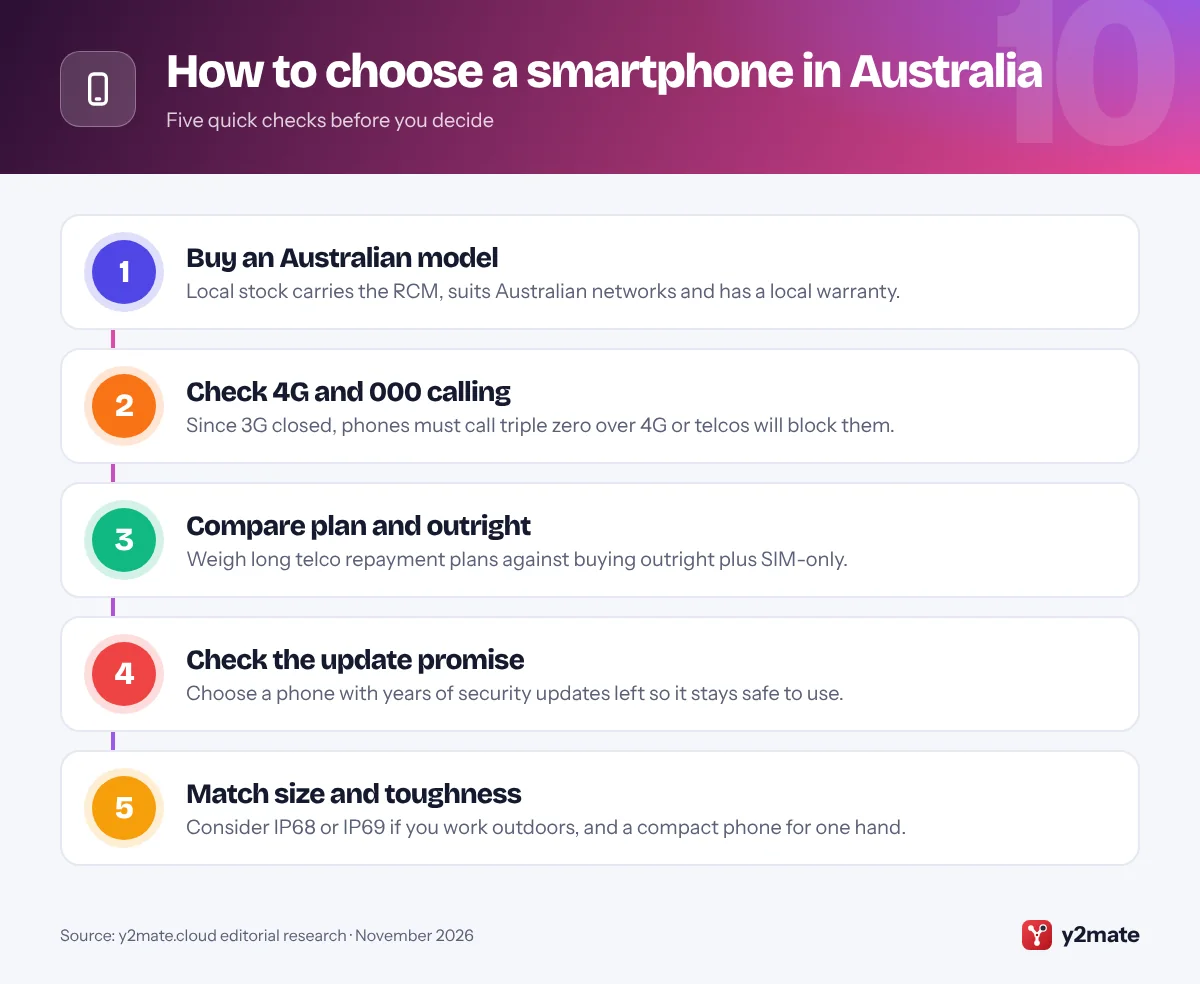
Check 4G calling and triple zero
All three networks have switched off 3G, so a phone must make voice calls over 4G (VoLTE), including emergency calls. Under ACMA rules, telcos must identify and block phones that cannot call triple zero (000) over 4G. Every phone on this list is an Australian model, but if you buy elsewhere, check with your telco first, and never call 000 just to test a phone.
Avoid grey imports
- RCM: look for the Regulatory Compliance Mark on the box or in the phone’s settings, which shows it meets Australian standards.
- Bands: overseas models can miss low-band frequencies such as band 28, which carries much of Telstra’s and Optus’s regional 4G coverage.
- Warranty: grey imports may not be covered by the maker’s Australian warranty, so look for AU stock or the Australian version.
Finally, favour long update promises: Samsung and Google lead with six to seven years, OPPO offers five OS upgrades and six years of security fixes, and Apple commits to at least five years of security updates.
Frequently asked questions
What is the best smartphone in Australia in 2026?
For iPhone users, the iPhone 18 Pro is the best choice, with a variable-aperture camera and both nano-SIM and eSIM in Australian models. The Samsung Galaxy S26 Ultra is the best Android phone for power users, the OPPO Find X10 Pro Max leads for zoom and battery stamina, and the Pixel 10a is the best value thanks to seven years of updates.
Will my phone still work after the 3G shutdown?
Only if it can make voice calls, including triple zero (000) calls, over 4G. Telstra, Optus and Vodafone have closed their 3G networks, and telcos must block phones that cannot reach 000 over 4G. Current models sold in Australia support this, but older or imported phones may not. Ask your telco to check your handset, and do not call 000 to test it.
Is it safe to buy a grey import phone in Australia?
It carries risks. The ACMA warns that phones sold online or from overseas may not meet Australian standards and may not work on local networks, including for emergency calls. A grey import can also lack Australian bands and may not be covered by the local warranty. Look for the RCM and an Australian model, and check with your telco before buying.
What does the RCM mark mean?
The Regulatory Compliance Mark (RCM) shows that a supplier has tested a product and confirmed it meets Australian standards before selling it here. On phones it may be printed on the packaging or shown in the settings menu, usually under a legal or regulatory section. An overseas mark such as CE or FCC does not mean a phone meets Australian rules.
How many years of updates do phones get in Australia?
It depends on the maker. Samsung promises seven years of OS and security updates for the Galaxy S26 Ultra and Z Flip8, and six for the Galaxy A57 5G and A17 5G. Google promises seven years for the Pixel 11 series and Pixel 10a. OPPO offers five OS upgrades and six years of security updates, and Apple commits to at least five years of security updates.
Final verdict
The best smartphones in Australia in 2026 are the iPhone 18 Pro for iPhone users, the Galaxy S26 Ultra for Android power users and the OPPO Find X10 Pro Max for zoom photography and battery stamina. The Pixel 11 Pro and iPhone 17 are strong mainstream picks, the Galaxy Z Flip8 is the best foldable, the OPPO Reno16 Pro is the compact choice, and the Galaxy A57 5G, Pixel 10a and Galaxy A17 5G deliver the most for less.
Whatever you choose, buy an Australian model with the RCM, confirm it can call triple zero over 4G on your network, and favour phones with years of updates still to come.
Sources and further reading
- ACMA on phones bought overseas: The ACMA explains why phones sold online or from overseas may not meet Australian standards or work on local networks.
- Mobiles and 000 after 3G: The ACMA's rules requiring telcos to identify and block phones that cannot call triple zero after the 3G shutdown.
- 3G network switch-off: Australian Government information on the 3G shutdown and how to check whether your phone is affected.
- How to spot a dodgy device: ACMA tips on checking for the Regulatory Compliance Mark and avoiding non-compliant devices sold online.

Leave a Reply