
- The Apple iPhone 18 Pro, Samsung Galaxy S26 Ultra and Google Pixel 11 Pro are the strongest all-round smartphones on sale in the USA in 2026.
- iPhones sold in the US since the iPhone 14 and the Pixel 11, Pixel 11 Pro and Pixel 11 Pro XL are eSIM-only, so your carrier must support eSIM activation.
- Samsung promises seven generations of Android upgrades and seven years of security updates for the Galaxy S26 and Z8 foldables, and Google promises seven years of updates for the Pixel 11 series and Pixel 10a.
- Carriers generally unlock postpaid phones once they are paid off, and in January 2026 the FCC let Verizon drop its 60-day automatic unlocking rule.
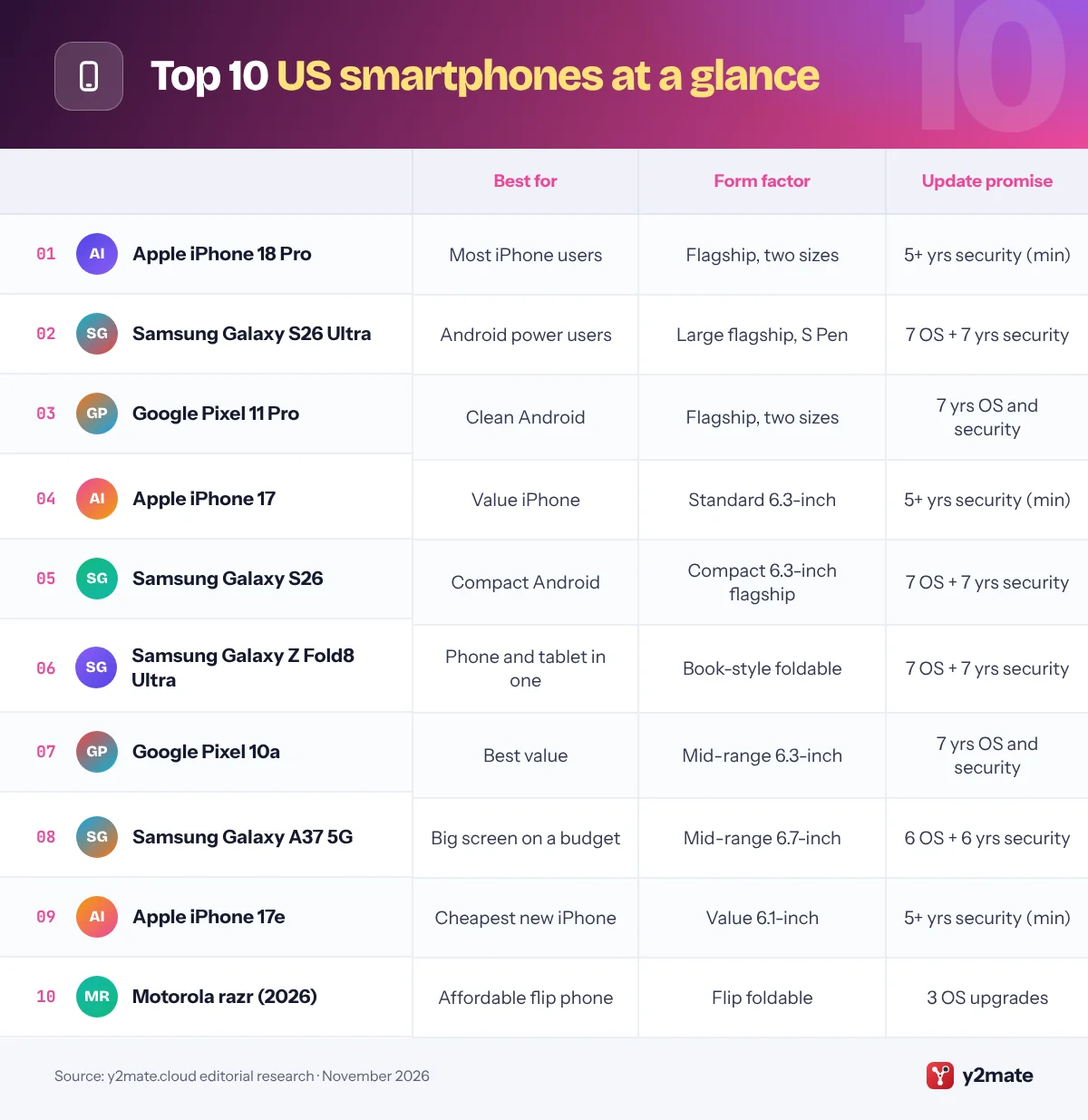
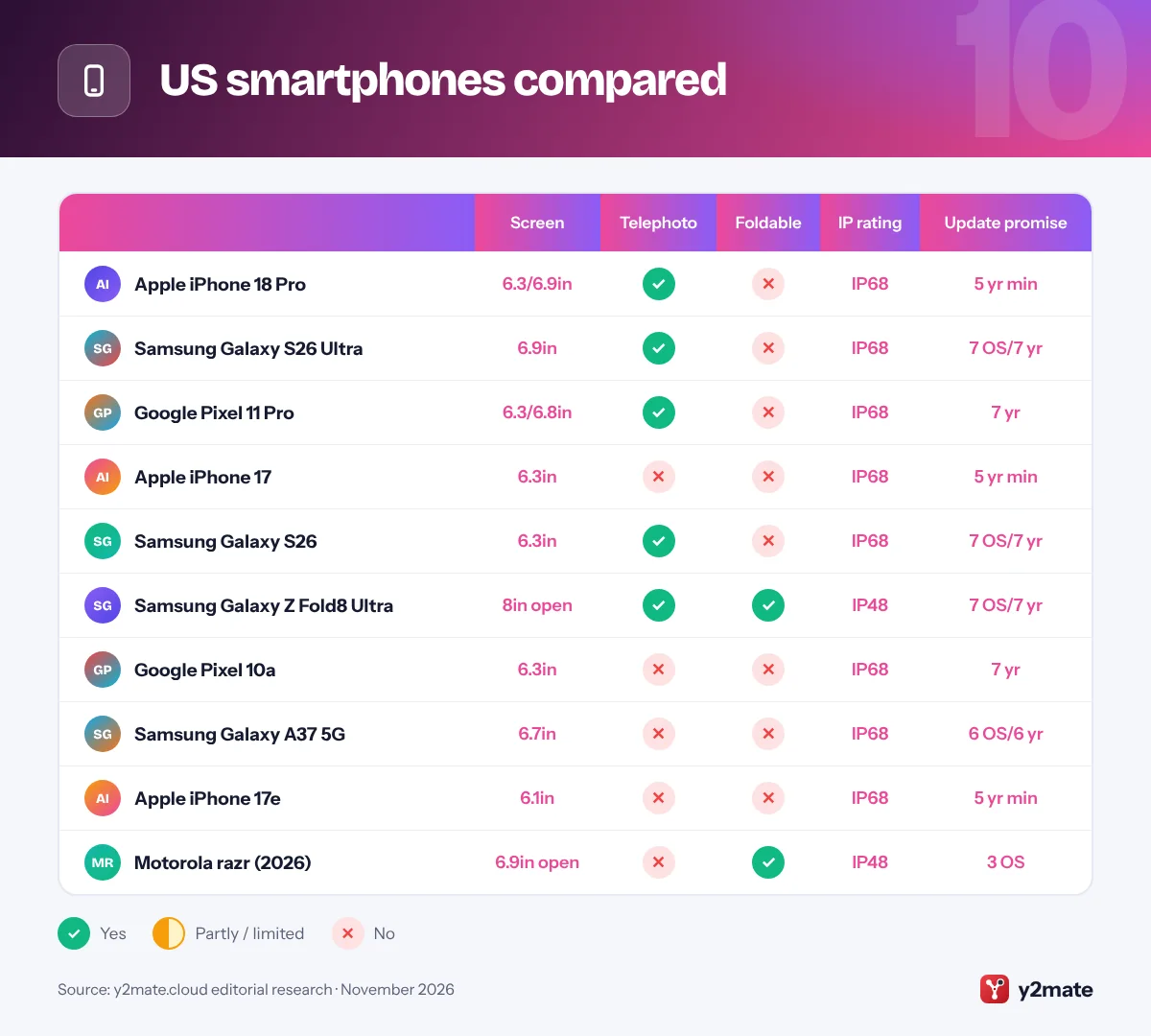
The best smartphones in the USA in 2026 are the Apple iPhone 18 Pro for most iPhone buyers, the Samsung Galaxy S26 Ultra for Android power users and the Google Pixel 11 Pro for clean software with seven years of updates. The iPhone 17, Galaxy S26, Galaxy Z Fold8 Ultra, Pixel 10a, Galaxy A37 5G, iPhone 17e and Motorola razr (2026) complete the list, covering compact, foldable, mid-range and value picks that are all sold officially in the US.
A few terms matter more in the US than elsewhere. An eSIM is a digital SIM built into the phone that your carrier activates over the air; every iPhone sold in the US since the iPhone 14 is eSIM-only. An unlocked phone works with any compatible carrier, while a carrier-locked phone works only with the carrier that sold it until it is unlocked. Bands are the radio frequencies a network uses, and a phone needs the right ones for full coverage on T-Mobile, Verizon or AT&T. An update policy is the maker’s promise of how long it will deliver new software versions and security fixes.
This guide ranks ten phones on those practical points and explains carrier deals, unlocking rules and what to check before you buy.
How we ranked this list
We compared publicly documented information only: each maker’s official software-update commitment, whether the phone is sold officially in the US by the maker or the major carriers, size and form factor, the camera system and battery as described by the maker and in launch coverage, and durability ratings such as IP68. We confirmed that every model is sold officially in the US.
We did not test the phones ourselves and do not quote prices, speed test results or battery figures, which change often and vary by model. OnePlus is not included because it said in July 2026 that it would stop launching new phones in North America and Europe.
The Top 10 Smartphones
1. Apple iPhone 18 Pro
Best for: iPhone users who want the top camera and battery
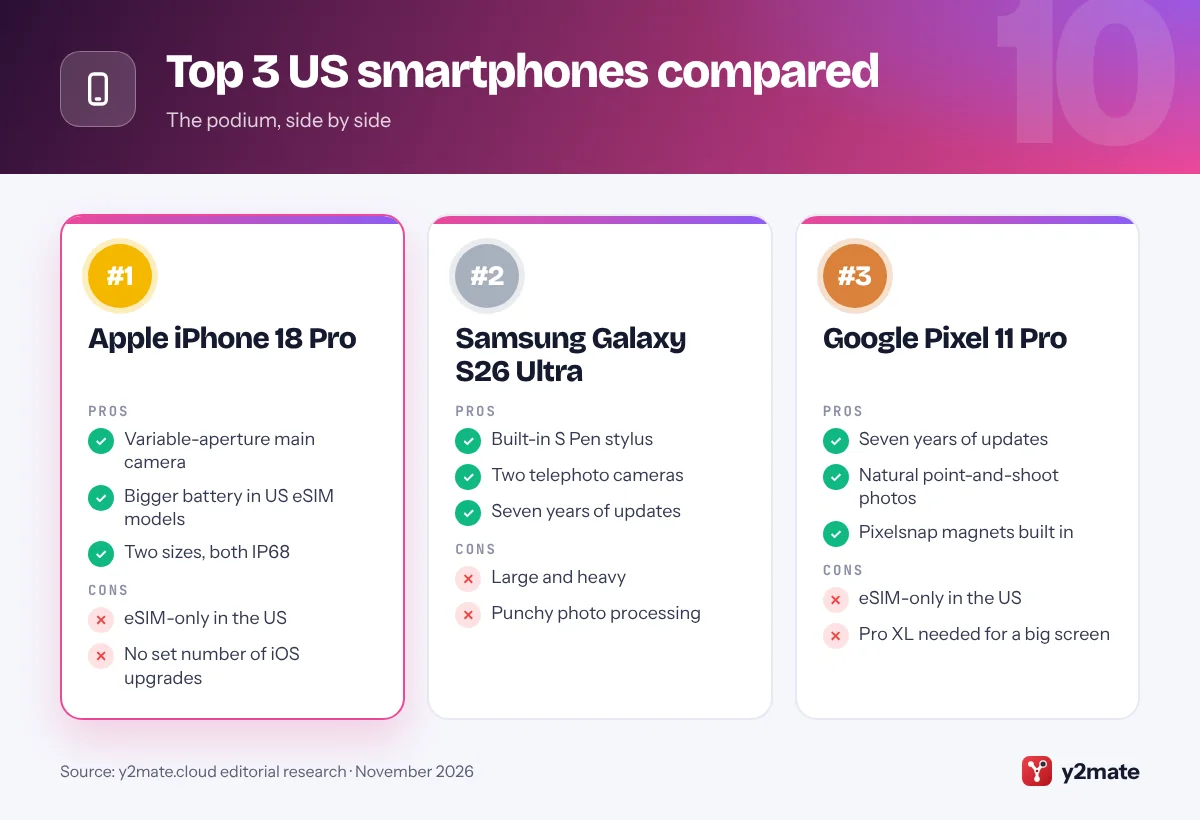
The iPhone 18 Pro and the larger iPhone 18 Pro Max, launched in September 2026, are the best all-round smartphones in the USA for people who prefer iOS. The headline upgrade is a main camera with a variable aperture, meaning the lens can physically change how much light it lets in, and Apple has added manual Pro controls for aperture, shutter speed and white balance in the Camera app.
US models are eSIM-only, and Apple says it used the space once taken by the SIM tray for a larger battery. They also debut Apple’s own C2 modem, which supports the mmWave 5G that some US carriers offer in busy city areas. Both sizes run the new A20 Pro chip, are rated IP68 and share the new main camera, so you can choose mostly on screen size.
Apple does not promise a set number of iOS upgrades, but it has stated a minimum of five years of security updates from first supply for iPhones in its UK compliance filings, and older iPhones have usually been supported for longer. If you buy through a carrier, confirm it supports eSIM activation and transfer. For most iPhone users, this is the phone to get.
Official site: Apple iPhone 18 Pro
- Variable-aperture main camera
- Bigger battery in US eSIM models
- Two sizes, both IP68
- eSIM-only in the US
- No set number of iOS upgrades
2. Samsung Galaxy S26 Ultra
Best for: Android power users who want a stylus and zoom
The Galaxy S26 Ultra is the most complete Android phone sold in the US. Its large 6.9-inch display works with a built-in S Pen stylus, and it is the only S26 model with Samsung’s Privacy Display, which can stop people beside you from reading your screen. The camera system pairs a high-resolution main camera with an ultrawide and two telephoto cameras, so it covers everything from wide landscapes to distant subjects.
Samsung promises seven generations of Android OS upgrades and seven years of security updates, which comfortably outlasts a typical carrier payment plan. The phone is rated IP68 and uses Qualcomm’s Snapdragon 8 Elite Gen 5 for Galaxy chip.
You can buy it unlocked from Samsung or on a payment plan from Verizon, AT&T or T-Mobile. It is large and heavy, so it does not suit people who want a pocketable phone, and Samsung’s processing gives bright, punchy photos that not everyone prefers. For anyone who uses a phone as a pocket computer, takes handwritten notes or zooms a lot, it is the best Android choice in the US.
Official site: Samsung Galaxy S26 Ultra
- Built-in S Pen stylus
- Two telephoto cameras
- Seven years of updates
- Large and heavy
- Punchy photo processing
3. Google Pixel 11 Pro
Best for: clean Android software and long support
The Pixel 11 Pro, launched in August 2026 alongside the larger Pixel 11 Pro XL, is the best choice if you want Android as Google designs it, with new features arriving through regular Pixel Drops. It runs Google’s Tensor G6 chip with a new Titan M3 security chip, and Google promises seven years of OS, security and Pixel Drop updates, counted from when the phone first went on sale in the US Google Store.
The camera system includes a telephoto camera with optical image stabilization, and Google’s processing is known for natural, dependable results with little effort. Both Pro models are rated IP68, use Gorilla Glass Victus 2 front and back, and have Pixelsnap magnets built in for Qi2 accessories.
Like recent iPhones, the Pixel 11, Pixel 11 Pro and Pixel 11 Pro XL are eSIM-only in the US, while the Pixel 11 Pro Fold keeps a SIM tray. Google sells them unlocked and through major carriers. If you value simple software, long support and great point-and-shoot photos, the Pixel 11 Pro is the Android phone to beat.
Official site: Google Pixel 11 Pro
- Seven years of updates
- Natural point-and-shoot photos
- Pixelsnap magnets built in
- eSIM-only in the US
- Pro XL needed for a big screen
4. Apple iPhone 17
Best for: most iPhone buyers who want value
The iPhone 17 is the best-value iPhone for most people in 2026. It has a 6.3-inch display with a smooth, high refresh rate, Apple’s A19 chip, a dual rear camera with main and ultrawide lenses, and a Center Stage front camera that can widen the frame for group selfies without you turning the phone. It is rated IP68, supports MagSafe accessories and includes the Action button and Camera Control.
Compared with the iPhone 18 Pro, you give up the telephoto camera, the variable aperture and some battery life, but for everyday photos, messages and video calls the difference is small. Like every iPhone sold in the US since the iPhone 14, it is eSIM-only, which makes switching carriers quick if your new carrier supports eSIM transfer.
It follows Apple’s usual support pattern, with yearly iOS upgrades for as long as Apple chooses to support it and a stated minimum of five years of security updates. If you want a modern iPhone without paying for Pro features you will not use, start here, and step up to the 18 Pro only if zoom or battery life matter most to you.
Official site: Apple iPhone 17
- Smooth 6.3-inch display
- Center Stage front camera
- IP68 with Camera Control
- No telephoto camera
- eSIM-only in the US
5. Samsung Galaxy S26
Best for: a compact Android flagship
The Galaxy S26 is the smallest phone in Samsung’s 2026 flagship range, with a 6.3-inch display, and it brings most of the Ultra’s Galaxy AI software to a size that suits one-handed use. It keeps a main, ultrawide and telephoto camera, so you still get optical zoom, and it is rated IP68.
It gets the same promise as the Ultra: seven generations of Android OS upgrades and seven years of security updates. US models use Qualcomm’s Snapdragon chip, while Samsung fits its own Exynos 2600 in some other markets, so read reviews of the US version if performance matters to you.
The trade-offs are a smaller battery than the Ultra and no S Pen or Privacy Display. It is sold unlocked by Samsung and through the major US carriers, often with trade-in offers linked to a new line or plan, so compare the total cost over the whole agreement rather than the monthly figure. If you want a powerful Android phone that fits easily in a pocket and will be supported for years, the Galaxy S26 is the best compact choice in the US.
Official site: Samsung Galaxy S26
- Pocket-friendly 6.3-inch size
- Telephoto camera
- Seven years of updates
- Smaller battery than the Ultra
- No S Pen or Privacy Display
6. Samsung Galaxy Z Fold8 Ultra
Best for: a tablet-sized screen that folds into a pocket
The Galaxy Z Fold8 Ultra, announced in July 2026, is the best book-style foldable sold in the US. It opens into an 8-inch main screen for split-screen apps, documents and video, then closes to a full-width 6.5-inch cover screen that works like a normal phone. Samsung also launched a standard Galaxy Z Fold8 with a wider, passport-style shape, but only the Ultra gets a telephoto camera and the higher-resolution main camera.
Like Samsung’s other 2026 flagships, the Z8 foldables are promised seven generations of OS upgrades and seven years of security updates. The Fold8 Ultra is rated IP48, which means it is protected against immersion in fresh water under test conditions but has only limited dust protection, so it needs more care at the beach or on a building site than an IP68 phone.
Apple’s first foldable, the iPhone Duo, went on sale in October 2026 and is worth considering if you are committed to iOS, but it is a first-generation design. For most people who want a foldable that doubles as a small tablet, the Fold8 Ultra is the most proven option on US shelves.
Official site: Samsung Galaxy Z Fold8 Ultra
- 8-inch screen for multitasking
- Telephoto camera
- Seven years of updates
- IP48, limited dust protection
- Bulkier than a regular phone
7. Google Pixel 10a
Best for: the longest update support for the money
The Pixel 10a, released in March 2026, is the best value smartphone in the US because it pairs a modest price with the same seven-year promise of OS, security and Pixel Drop updates as Google’s flagships. Few phones at this level are supported for as long, which makes it a sensible choice for students, parents buying a first phone for a child and anyone who keeps a phone for years.
It has a 6.3-inch display, an IP68 rating and a flat, simple design, with main and ultrawide cameras backed by Google’s photo processing, including Night Sight for low light. There is no telephoto lens, so zoomed shots look softer than on the Pixel 11 Pro.
Google sells the Pixel 10a unlocked, and it is also offered by carriers and prepaid brands. Carrier versions bought on a payment plan or prepaid usually stay locked for a period, so check the unlocking terms before you buy. If you want a dependable, well-supported Android phone without flagship spending, the Pixel 10a is the easiest recommendation, and its software matches what Pixel 11 owners get.
Official site: Google Pixel 10a
- Seven years of updates
- IP68 at a lower price
- Reliable Pixel photo processing
- No telephoto lens
- Not the newest Tensor chip
8. Samsung Galaxy A37 5G
Best for: a big screen and long support on a budget
The Galaxy A37 5G, on sale in the US since April 2026, is the best mid-range Android phone for buyers who want Samsung’s software without paying flagship prices. It has a 6.7-inch AMOLED display, an IP68 rating, and Samsung’s promise of six generations of Android OS upgrades and six years of security updates, which is long for this part of the market.
Samsung sells it unlocked through its own store, and carrier versions are available too, including from T-Mobile. Its cameras handle everyday shots well in good light, but there is no telephoto lens, and its chip is a step below the Galaxy S26 range, so demanding games and heavy multitasking feel less fluid.
If you want a little more, the Galaxy A57 5G is also sold in the US and sits above it in Samsung’s range. For a large, water-resistant phone that will keep getting updates into the 2030s, the A37 is a smart buy, especially for anyone moving from an older Galaxy who wants familiar software and settings.
Official site: Samsung Galaxy A37 5G
- IP68 water resistance
- Six years of updates
- Large 6.7-inch AMOLED
- No telephoto lens
- Slower than flagships
9. Apple iPhone 17e
Best for: the most affordable new iPhone
The iPhone 17e, released in March 2026, is the lowest-cost new iPhone Apple sells, and it now starts with double the storage of the model it replaced. It has a 6.1-inch display, Apple’s A19 chip, a single Fusion camera with an optical-quality 2x option for portraits, and an IP68 rating. It also adds MagSafe, so it works with magnetic chargers, wallets and stands.
Inside is Apple’s C1X modem, and like other US iPhones it is eSIM-only, holding two active eSIMs at once. The main compromise is the single rear camera, with no ultrawide lens for wide scenes or group shots in tight rooms.
It receives the same iOS upgrades as Apple’s other current iPhones, with Apple’s stated minimum of five years of security updates. That makes it a strong choice for teenagers, older relatives or anyone moving from an older iPhone who wants Apple’s ecosystem at the lowest entry point. If you need a better camera or a larger screen, the iPhone 17 is worth the step up.
Official site: Apple iPhone 17e
- MagSafe charging support
- IP68 water resistance
- Same A19 chip as iPhone 17
- Single rear camera
- eSIM-only in the US
10. Motorola razr (2026)
Best for: a fun flip phone at a lower price
The Motorola razr (2026) is Motorola’s entry-level flip phone and one reason foldables have gone mainstream in the US. It folds in half into a small square that slips into any pocket, and its 3.6-inch external display lets you reply to messages, check maps and take selfies with the main cameras without opening it. Unfolded, it has a 6.9-inch inner display.
It is rated IP48, supports wireless charging and is sold unlocked by Motorola in the US. The razr+ and razr ultra sit above it in the 2026 range, and Motorola sells the same family under different names, such as razr 70, in some other countries, so check the US model name before buying from abroad.
The main drawback is software support. Motorola promises three Android OS upgrades for this model, well short of the seven offered on Samsung and Google flagships, so it suits buyers who replace their phone every few years. If you want a stylish, compact flip phone for less than a Galaxy Z Flip, the razr is the pick.
Official site: Motorola razr (2026)
- 3.6-inch outer screen
- Folds to a tiny square
- Wireless charging
- Only three OS upgrades
- IP48, limited dust protection
US smartphones compared
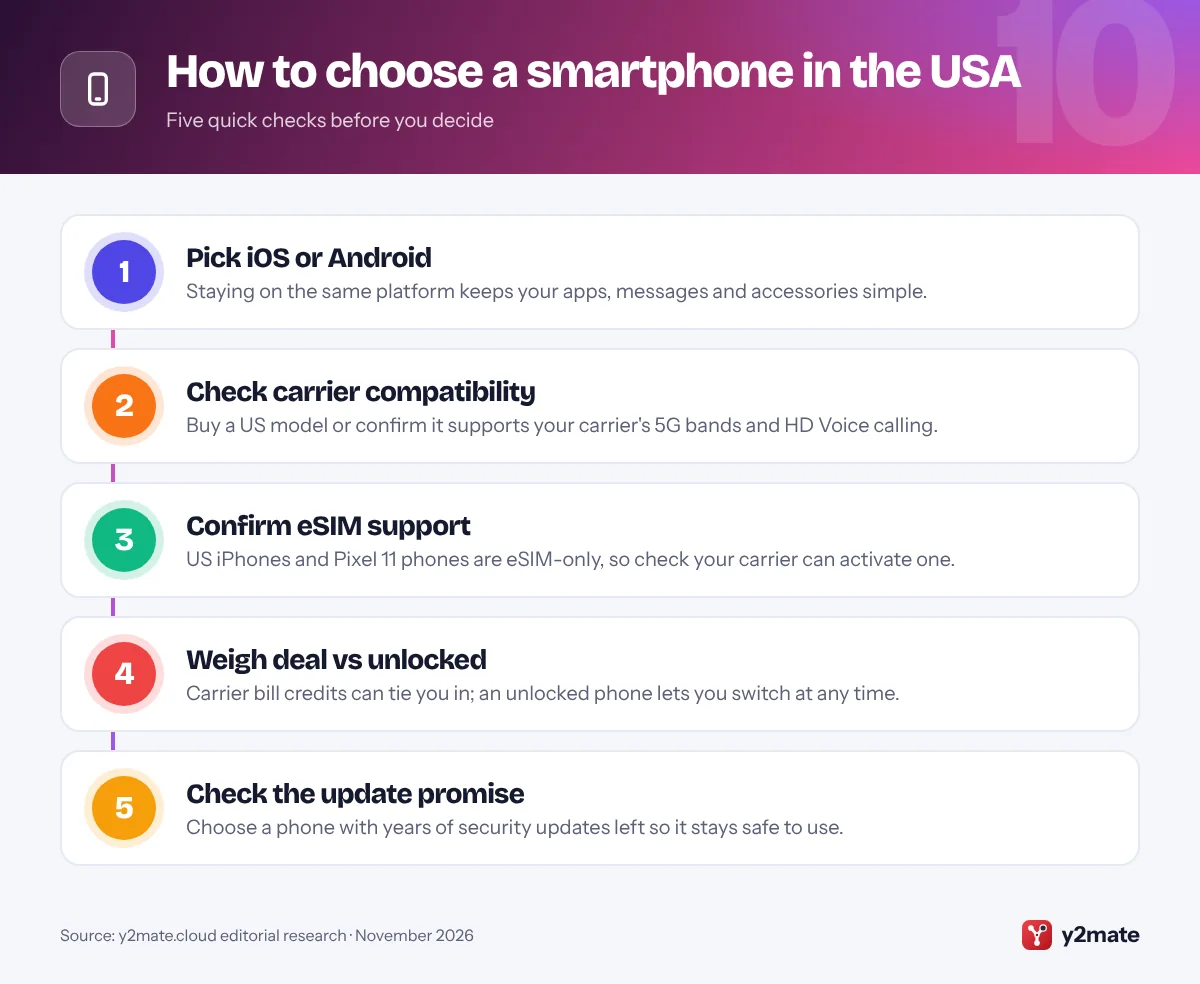
How to choose between smartphones in the USA
Start with the platform you already use. Moving between iPhone and Android is easier than it used to be, but your apps, messages and accessories are simplest to keep if you stay put. Then decide how you want to pay, and favor phones with years of security updates still to come.
Carrier deal or unlocked?
Verizon, AT&T and T-Mobile often discount phones through bill credits spread over a long payment plan. The catch is that the phone is usually locked to that carrier until it is paid off, and leaving early can cancel the remaining credits. Buying unlocked from the maker costs more up front but lets you move to any compatible carrier or a cheaper prepaid brand at any time.
Unlocking rules
Under the industry’s voluntary unlocking code, which the FCC describes on its consumer pages, carriers generally unlock postpaid phones once the device is paid off and prepaid phones within a year of activation. In January 2026 the FCC let Verizon drop its stricter 60-day automatic unlocking requirement and follow that code, and a proposal for a nationwide unlocking rule was still pending in fall 2026.
eSIM, bands and calling
- eSIM: US iPhones and Pixel 11 phones have no SIM tray, so your carrier must support eSIM activation.
- Bands: phones sold officially in the US support the C-band 5G used by Verizon and AT&T and T-Mobile’s mid-band 5G; imported models may not.
- Calling: some carriers only enable HD Voice (VoLTE) calling on devices they have approved, so a gray-market import may struggle to make calls.
Frequently asked questions
What is the best smartphone in the USA in 2026?
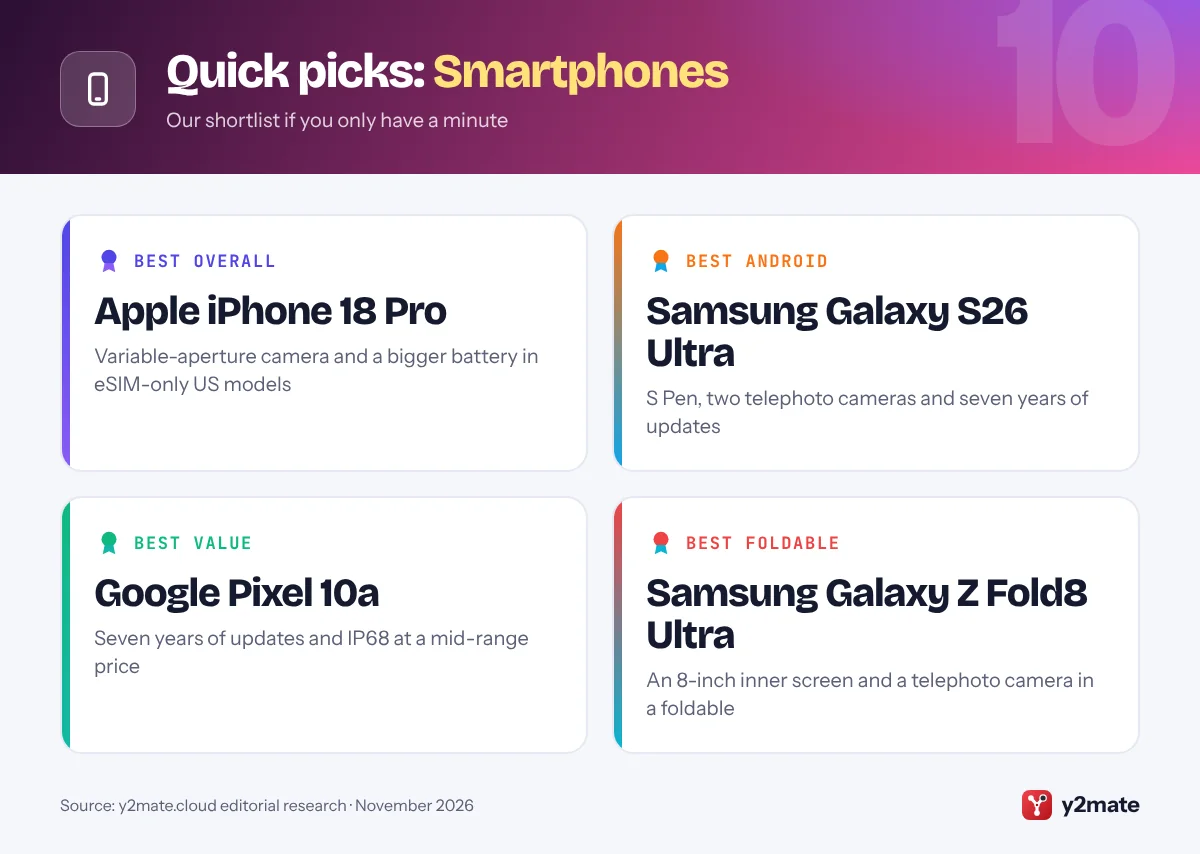
For most iPhone users, the iPhone 18 Pro is the best choice thanks to its variable-aperture camera and a bigger battery in the eSIM-only US models. The Samsung Galaxy S26 Ultra is the best Android phone for power users, the Google Pixel 11 Pro is best for clean software and seven years of updates, and the Pixel 10a is the best value pick.
Is it better to buy a phone from a carrier or unlocked?
Carrier deals can cut the cost through bill credits, but the phone usually stays locked until it is paid off, and leaving early can cancel the remaining credits. An unlocked phone bought from Apple, Samsung, Google or Motorola costs more up front but lets you switch carriers or move to a cheaper prepaid plan whenever you like. Compare the total cost over the whole term.
What does eSIM-only mean?
An eSIM is a SIM built into the phone that your carrier activates digitally, so there is no SIM card to insert. iPhones sold in the US since the iPhone 14, and Google's Pixel 11, Pixel 11 Pro and Pixel 11 Pro XL, are eSIM-only. Verizon, AT&T and T-Mobile all support eSIM, but check that any prepaid brand you plan to use supports it on your model.
When will my carrier unlock my phone?
Under the industry's voluntary unlocking code described by the FCC, carriers generally unlock postpaid phones once the device is paid off and prepaid phones within a year of activation, without charging an unlocking fee. In January 2026 the FCC let Verizon replace its 60-day automatic unlocking rule with this code, and a nationwide unlocking rule was still under consideration in fall 2026.
Will a phone bought overseas work in the US?
Not always. Phones made for other regions can lack the C-band 5G used by Verizon and AT&T or T-Mobile's mid-band 5G, and some carriers only enable HD Voice calling on devices they have approved. An imported phone may also have no US warranty support. Buying a US model from the maker, a carrier or a major retailer avoids these problems.
Final verdict
The best smartphones in the USA in 2026 are the iPhone 18 Pro for iPhone users, the Galaxy S26 Ultra for Android power users and the Pixel 11 Pro for clean software and long support. The iPhone 17 and Galaxy S26 are the sensible mainstream picks, the Galaxy Z Fold8 Ultra and Motorola razr (2026) cover both foldable styles, and the Pixel 10a, Galaxy A37 5G and iPhone 17e deliver the most for less.
Before you buy, decide between a carrier deal and an unlocked phone, confirm your carrier supports eSIM if you choose an iPhone or a Pixel 11, and favor phones with years of security updates still to come.
Sources and further reading
- FCC guide to cell phone unlocking: The FCC explains what unlocking means, when carriers will unlock your phone and whether an unlocked phone works on other networks.
- FCC eSIM FAQ: The FCC's plain-English answers on how eSIMs work and how to move service to a new carrier without a physical SIM card.
- FCC order on Verizon unlocking: The January 2026 FCC order that let Verizon replace its 60-day automatic unlocking rule with the industry unlocking code.
- FCC National Broadband Map: Check each carrier's reported 4G and 5G mobile coverage at your address before you choose a phone and plan.
- Pixel software update schedule: Google's official page listing how long each Pixel phone will receive Android and security updates.

Leave a Reply