
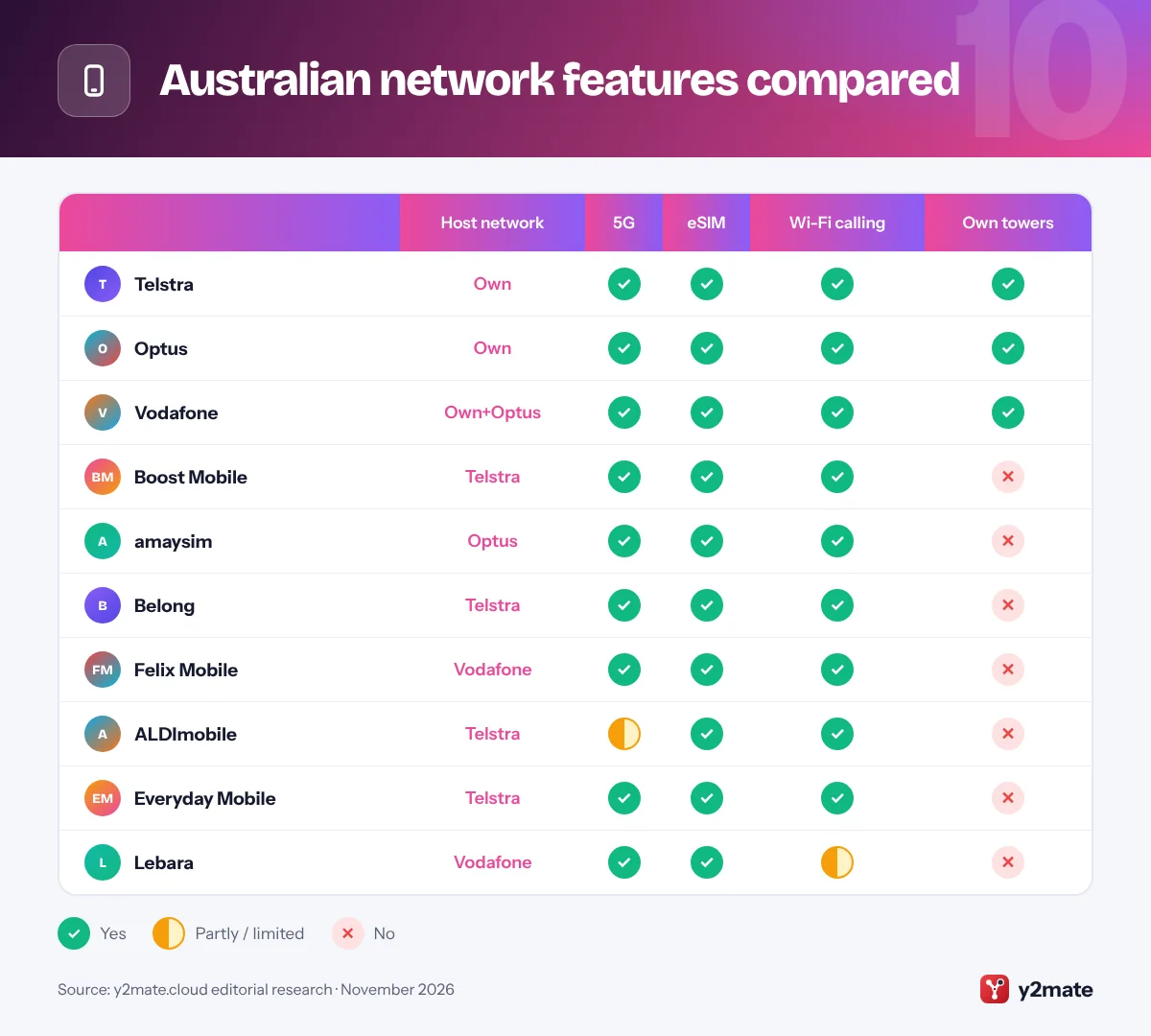
- Australia has three mobile network operators, Telstra, Optus and TPG Telecom's Vodafone, and every other provider, such as Boost Mobile, amaysim and Felix, rents capacity on one of them.
- Since early 2025 Vodafone customers have been able to use Optus's regional network under a sharing deal the ACCC did not oppose, greatly widening Vodafone's regional reach.
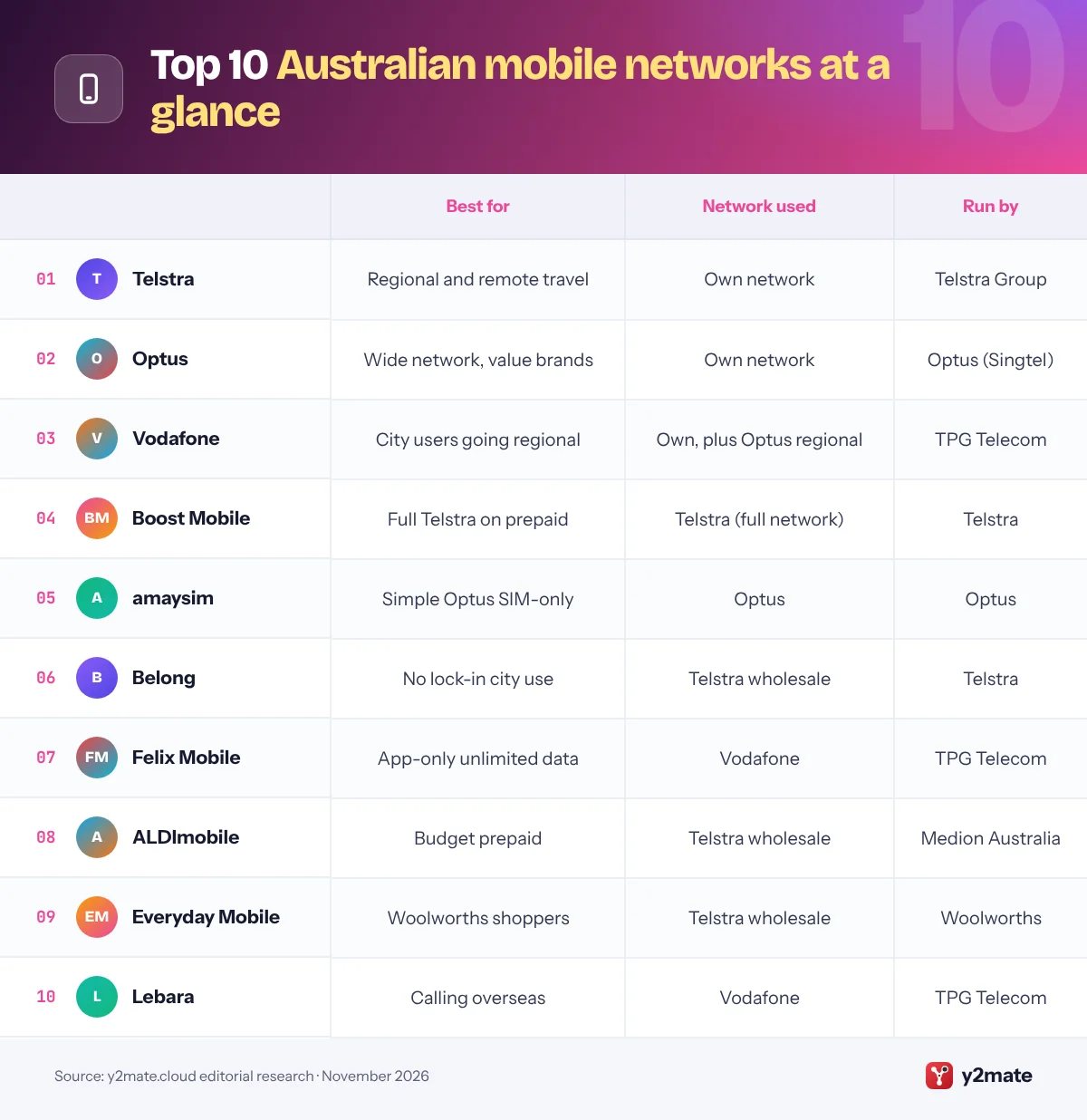
- Boost Mobile uses the full Telstra network, while Belong, ALDImobile and Everyday Mobile use Telstra's smaller wholesale network.
- All three networks have switched off 3G, and phones that cannot make triple zero (000) calls over 4G are blocked, so older handsets may need replacing.
- If your provider does not fix a complaint, the Telecommunications Industry Ombudsman (TIO) handles disputes for free.
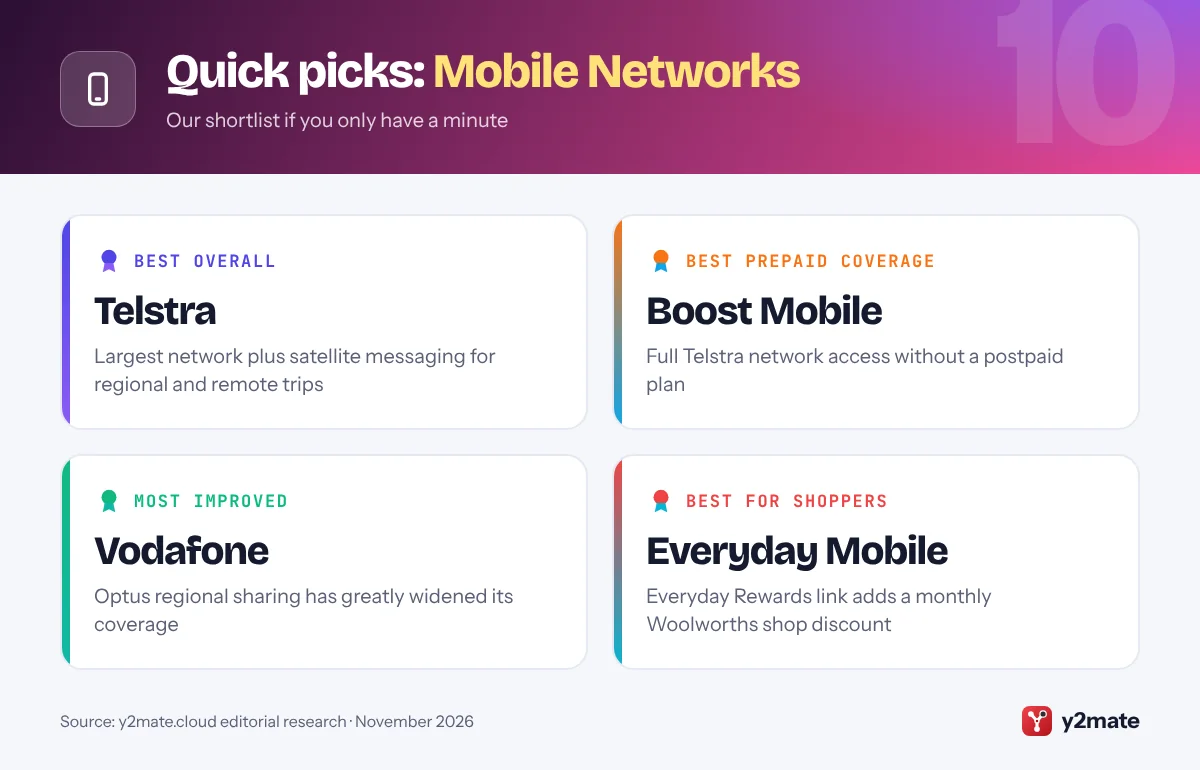
The best mobile networks in Australia in 2026 are Telstra for the largest coverage footprint and satellite messaging, Optus for a wide network and strong value brands, and Vodafone, run by TPG Telecom, which now reaches far more of regional Australia through a network-sharing deal with Optus. For lower costs, MVNOs such as Boost Mobile, amaysim, Belong and Felix Mobile use those same networks with simpler prepaid or SIM-only plans.
An MVNO, or mobile virtual network operator, is a provider that does not own towers. It buys access from Telstra, Optus or TPG and sells its own plans. Not all access is equal: some Telstra-based brands get the full Telstra network, while others use a smaller wholesale footprint that can miss parts of regional and remote Australia.
This list ranks ten mobile networks and MVNOs that matter to Australian buyers, explains whose network each uses, and covers the safety and consumer rules that apply, from triple zero (000) obligations to the Telecommunications Industry Ombudsman. It is for anyone switching providers, travelling regionally or buying a new phone.
How we ranked this list
We compared publicly documented information: coverage on each provider’s official map, including whether a Telstra-based brand uses the full or wholesale network, 5G and 5G standalone availability, eSIM and Wi-Fi calling support, international roaming options, prepaid and SIM-only flexibility, and how you can get help and escalate complaints. We also considered network reliability incidents investigated by the ACMA and widely reported customer feedback.
We did not run our own coverage or speed tests, and we do not list prices or data allowances, which change frequently. Check each provider’s coverage map for your address and the places you travel before you sign up.
The Top 10 Mobile Networks
1. Telstra
Best for: regional travel and the widest coverage
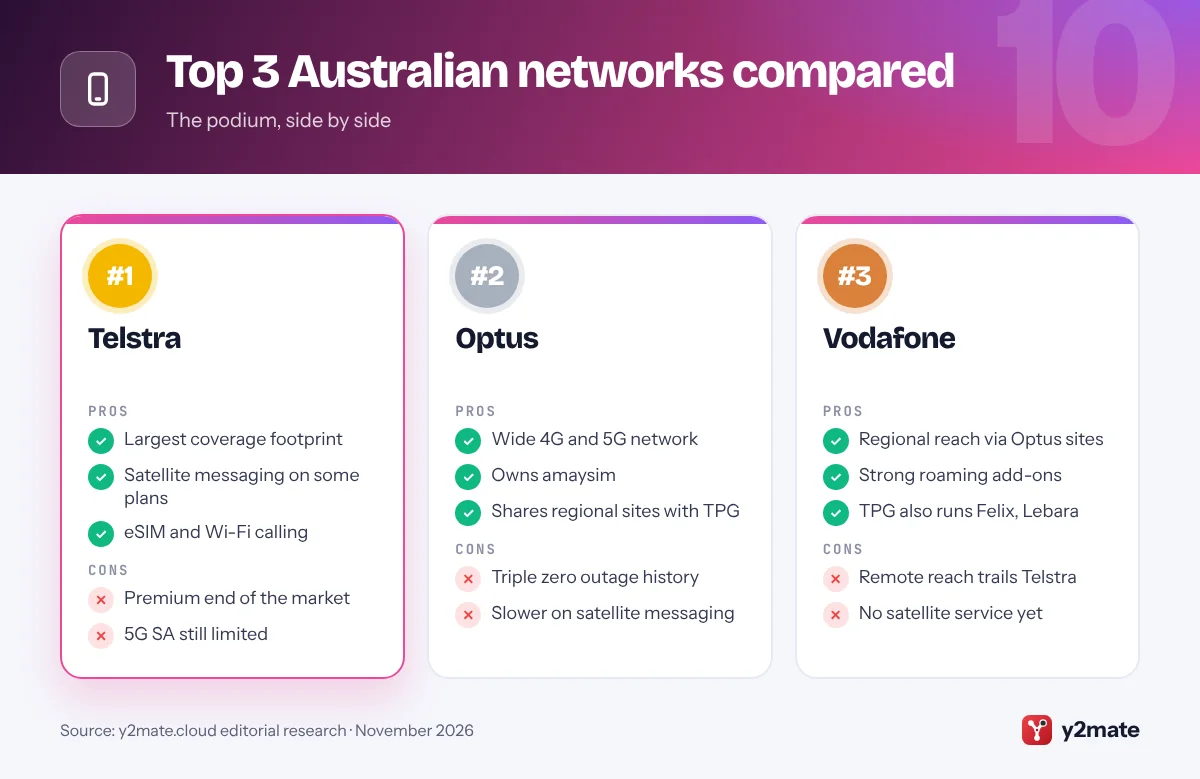
Telstra runs Australia’s largest mobile network and is usually the safest choice if you travel through regional and remote areas, work on the land or simply want the fewest black spots. It offers 4G and 5G nationally, with 5G standalone available in limited but growing areas on compatible phones. 5G standalone (5G SA) means 5G that runs on its own 5G core rather than depending on a 4G core, which can make connections more responsive.
Telstra was the first Australian telco to launch satellite-to-mobile messaging, built with Starlink, in 2025. It lets selected phones on eligible plans send texts where there is no mobile coverage, and Telstra has since added access to some messaging apps, though it is not a replacement for calling triple zero. Telstra supports eSIM, Wi-Fi calling, prepaid and postpaid plans, and international roaming, and it owns Boost Mobile and Belong.
The trade-off is cost: Telstra’s own plans generally sit at the top of the market. If you rarely leave the city, you may not need its extra reach, and a Telstra-based MVNO such as Boost Mobile can deliver much of the same coverage on prepaid.
Official site: Telstra
- Largest coverage footprint
- Satellite messaging on some plans
- eSIM and Wi-Fi calling
- Premium end of the market
- 5G SA still limited
2. Optus
Best for: a wide network with strong value brands
Optus, owned by Singapore’s Singtel, runs Australia’s second-largest mobile network, with 4G and 5G across the capital cities and many regional areas. It shares its regional network with TPG Telecom, so Vodafone customers now use Optus towers in much of regional Australia, and it owns the popular MVNO amaysim.
Optus supports eSIM, Wi-Fi calling, postpaid and prepaid plans and international roaming, and its network covers most places that Australians live and work. It signed a satellite partnership with SpaceX’s Starlink before Telstra did, but it has been slower to bring satellite messaging to its customers.
Reliability is the big question. A nationwide outage in November 2023 and a September 2025 failure that stopped some triple zero calls from connecting led to tougher national rules, and the ACMA has taken Optus to the Federal Court over the 2025 incident. Further outages affecting emergency calls were reported in 2026. Optus still offers broad coverage and competitive plans, but if network resilience is your top concern, weigh this history carefully before you sign up.
Official site: Optus
- Wide 4G and 5G network
- Owns amaysim
- Shares regional sites with TPG
- Triple zero outage history
- Slower on satellite messaging
3. Vodafone
Best for: city users who now need regional reach
Vodafone is the mobile brand of TPG Telecom, formed when Vodafone Hutchison Australia and TPG merged in 2020. Historically its network was strong in cities but thin in the bush. That changed in early 2025, when a regional network-sharing deal with Optus, which the ACCC decided not to oppose, gave Vodafone customers access to thousands of Optus regional sites and greatly expanded the area Vodafone covers.
Vodafone supports eSIM, Wi-Fi calling and both postpaid and prepaid plans, and its international roaming add-ons are popular with travellers. TPG also runs other brands on the Vodafone network, including Felix Mobile and Lebara. Vodafone has tested satellite texting to ordinary smartphones with Lynk Global but has not announced a commercial launch.
Remote coverage still trails Telstra, and the regional sites are Optus’s, so check the coverage map for the exact roads and towns you use. Vodafone switched off its 3G network earlier than its rivals, so very old phones will not work on it. For city dwellers who sometimes travel regionally, Vodafone is now a much stronger option than it was a few years ago.
Official site: Vodafone
- Regional reach via Optus sites
- Strong roaming add-ons
- eSIM and Wi-Fi calling
- Remote reach trails Telstra
- No satellite service yet
4. Boost Mobile
Best for: full Telstra coverage on prepaid
Boost Mobile is a prepaid brand that Telstra agreed to buy in December 2024, and it is best known for giving customers access to the full Telstra mobile network rather than the smaller wholesale footprint used by most Telstra-based MVNOs. That makes it one of the best ways to get Telstra’s regional reach without a postpaid plan.
Boost supports 5G on compatible phones, eSIM setup through its online account and Wi-Fi calling, which is switched on by default on compatible devices. Plans are prepaid, so there are no lock-in contracts and no surprise bills, and you can recharge online, in the app or at many retailers, with longer-expiry options for light users.
Telstra said Boost would continue as its own brand with no changes for customers on Boost prepaid plans, but as with any MVNO, you do not get every extra that Telstra’s own customers receive, and support is mainly online and by chat rather than in Telstra stores. Wi-Fi calling to emergency services is not supported while you are overseas. If you need Telstra-level coverage on a prepaid budget, Boost is the standout choice.
Official site: Boost Mobile
- Full Telstra network access
- Prepaid with no lock-in
- eSIM and Wi-Fi calling
- Not every Telstra extra
- Support mainly online
5. amaysim
Best for: simple prepaid plans on the Optus network
amaysim is one of Australia’s best-known MVNOs and has been owned by Optus since 2021. It runs on the Optus 4G and 5G network, with 5G available in selected areas on compatible plans and devices, and it focuses on straightforward SIM-only plans with no lock-in contract.
Everything is managed in the amaysim app, where you can activate or replace an eSIM, change plans and track usage. amaysim lists VoLTE and Wi-Fi calling among its features, offers international roaming add-ons, and has added number sharing for some smartwatches. As well as standard monthly-style plans, it sells longer-term plans for people who prefer to pay less often.
Because it uses Optus’s network, amaysim inherits Optus’s coverage and, in a major outage, Optus’s problems, so the reliability history covered above applies here too. Support is largely online and through the app, with no shopfronts. If Optus covers your area well and you want a no-fuss SIM-only plan you can manage from your phone, amaysim is a strong pick.
Official site: amaysim
- Optus 4G and 5G coverage
- Easy app-based eSIM
- Short and long plan options
- Shares Optus outage risk
- Mostly online support
6. Belong
Best for: no lock-in SIM-only for city users
Belong is Telstra’s own budget brand, offering SIM-only mobile plans with no lock-in contracts. It runs on Telstra’s wholesale mobile network, which reaches the vast majority of Australians but covers less of regional and remote Australia than Telstra’s full retail network, so it suits people who mostly live and travel in cities and larger towns.
Belong plans include 5G access on compatible phones, it supports eSIM on eligible plans, and its help centre explains how to set up Wi-Fi calling. The service is designed to be managed online and in its app. Belong also sells NBN home internet, so you can keep your mobile and home broadband with one provider and one login.
Belong is not the right choice if you spend time in remote areas, because the wholesale network has fewer towers there, and that is exactly where Telstra’s full network earns its keep. Support is online first, with no shops. If you want a Telstra-owned, no-contract plan for city and suburban use, Belong is a dependable option.
Official site: Belong
- Telstra-owned, no lock-in
- 5G on compatible phones
- Mobile and NBN in one place
- Smaller wholesale footprint
- No shops for support
7. Felix Mobile
Best for: app-only users who want unlimited data
Felix Mobile is a digital-only brand from TPG Telecom that runs on the Vodafone network, including 5G. It is built around a simple idea: plans with unlimited data at a capped speed, managed entirely in an app, with no lock-in contract.
Felix supports eSIM activation in its app, or a physical SIM if you prefer, and it includes VoLTE and Wi-Fi calling on all plans. It also markets itself as an environmentally conscious brand, which appeals to some buyers, and its app handles everything from sign-up to plan changes and support chats.
The capped speed is fine for streaming, browsing and video calls but less suited to heavy hotspot use for a whole household, and there are no stores or phone-first support. Wi-Fi calling also does not work while you are roaming overseas. Because Felix uses the Vodafone network, check Vodafone’s coverage map for the places you go. If you want a predictable unlimited-data plan on the Vodafone network and are comfortable doing everything in an app, Felix is a good fit.
Official site: Felix Mobile
- Unlimited data at capped speed
- eSIM and Wi-Fi calling
- No lock-in contract
- Speed cap limits heavy use
- App-only support
8. ALDImobile
Best for: budget prepaid on Telstra wholesale
ALDImobile is the supermarket chain’s prepaid mobile service, operated by Medion Australia and running on Telstra’s wholesale network. It is aimed at budget-conscious households and light to moderate users who want Telstra-based coverage in cities and larger towns without a contract.
ALDImobile says all of its Mobile Plans, Family Plans and Super Packs include Wi-Fi Calling as standard, and it now supports eSIM activation on compatible unlocked phones. 5G is available in selected areas on selected plans, and family plans let you manage several services together. You can pick up starter packs in ALDI stores or order online, and handsets need 4G calling with emergency call support to work on the network.
Because it uses the wholesale network rather than Telstra’s full footprint, coverage is thinner in regional and remote areas, and 5G access is more limited than on some rivals. Support is mostly online and by phone, and there are fewer extras than at bigger telcos. If you mainly stay in the city and want a simple prepaid plan from a familiar brand, ALDImobile is a sensible pick.
Official site: ALDImobile
- Wi-Fi calling as standard
- eSIM activation
- Buy in ALDI stores
- Wholesale network footprint
- 5G only on selected plans
9. Everyday Mobile
Best for: Woolworths shoppers on Telstra wholesale
Everyday Mobile from Woolworths, formerly Woolworths Mobile, is the supermarket’s mobile brand. It runs on Telstra’s wholesale network, including 5G on compatible phones in 5G areas, and offers 30-day prepaid recharges, long-expiry options and monthly SIM-only plans.
Its main draw is the link with Everyday Rewards: linking your card to an eligible plan can unlock a monthly discount on a Woolworths shop, which for regular shoppers may matter more than small differences between plans. It supports eSIM, including switching from a physical SIM in the Everyday Mobile app, and Wi-Fi calling on compatible devices when you are on a suitable Wi-Fi network.
Like other Telstra wholesale brands, its coverage is thinner in remote areas than Telstra’s own network, and the shopping discount has conditions and does not apply to every plan, so read the terms before you choose. Support is mainly online and by phone. If you shop at Woolworths every week and live in a well-covered area, Everyday Mobile is worth comparing with the other budget brands.
Official site: Everyday Mobile
- Everyday Rewards shopping perk
- eSIM switch in the app
- Wi-Fi calling supported
- Wholesale network footprint
- Perk excludes some plans
10. Lebara
Best for: international calling on Vodafone
Lebara is a prepaid brand owned by TPG Telecom that runs on the Vodafone 4G and 5G network. It has been part of the Vodafone business in Australia since 2016 and is built for people who call family and friends overseas, with many plans including international calls to a set list of countries, so you can skip separate calling cards or apps.
Lebara supports eSIM, VoLTE and Wi-Fi calling on approved devices, and it publishes a list of supported phones. That list is worth checking, because some handsets bought overseas may not work fully and Wi-Fi calling support varies by model and software version. Recharges are prepaid with no lock-in, and you can manage your service online or in its app.
As a Vodafone-based brand, Lebara’s coverage follows Vodafone’s map, and its support is mainly online. It has fewer extras than the larger providers and is not aimed at people who want bundles or premium features. If international calling is a regular part of your week and Vodafone covers your area, Lebara is one of the most practical choices on the market.
Official site: Lebara
- International calls on many plans
- Vodafone 4G and 5G network
- Prepaid with no lock-in
- Check approved device list
- Fewer extras than big telcos
Australian network features compared
How to choose between mobile networks in Australia
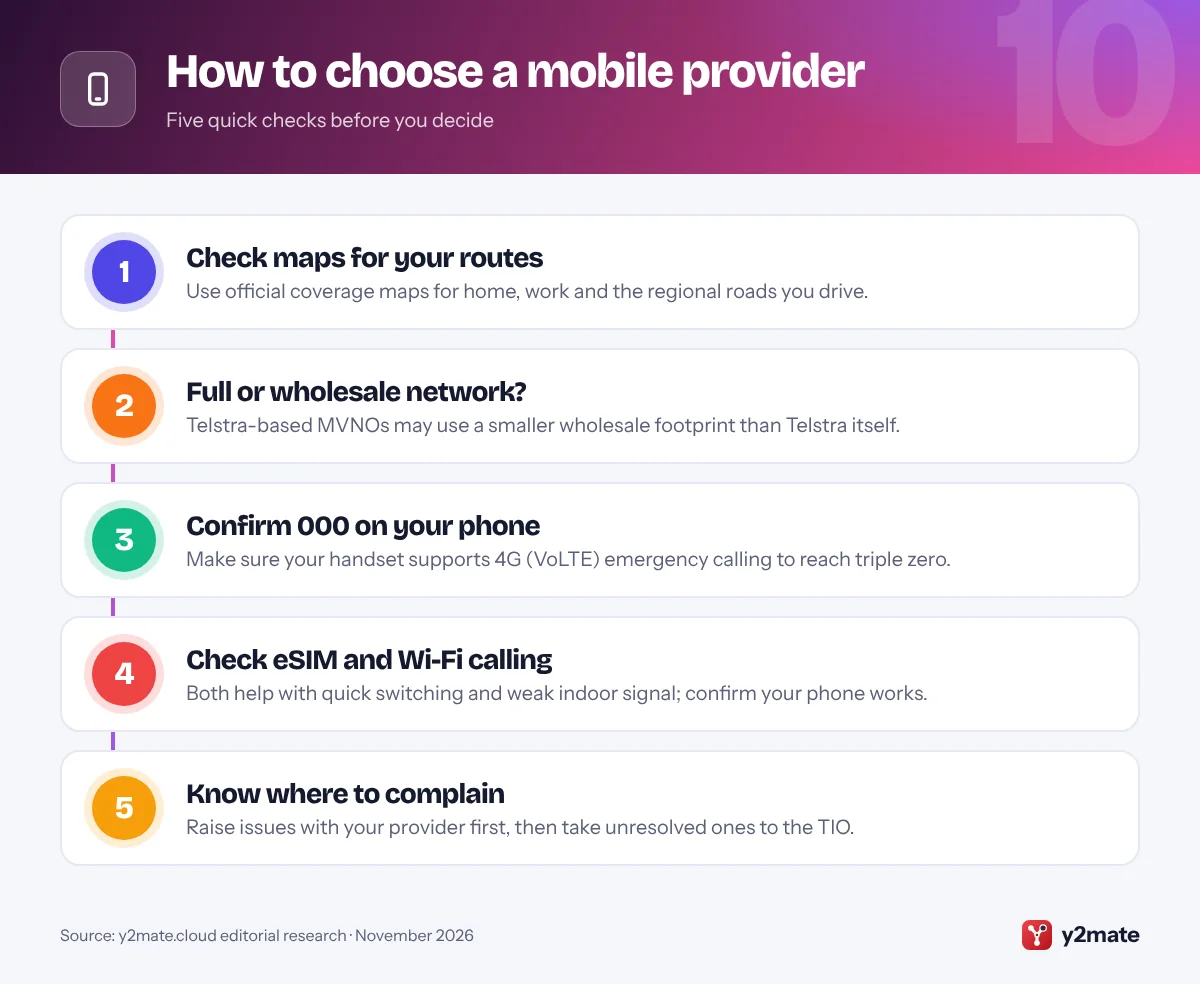
Start with coverage, especially if you drive between towns. Telstra has the largest footprint, Optus is next, and Vodafone now reaches much further into regional Australia through its sharing deal with Optus. Check each provider’s map for your home, work and the highways you use, and remember that an MVNO inherits its host’s coverage.
Who uses which network
- Telstra (full network): Telstra and Boost Mobile.
- Telstra wholesale: Belong, ALDImobile, Everyday Mobile and others.
- Optus: Optus and amaysim.
- Vodafone: Vodafone, Felix Mobile and Lebara.
Safety and your rights
- Triple zero: the 3G networks have closed, and phones that cannot make 000 calls over 4G are blocked. If you have an older or imported handset, check with your provider.
- Outages: after the Optus failures, the government set up a Triple Zero Custodian to oversee the emergency call system, raised penalties and added outage reporting rules, with the ACMA enforcing them.
- Coverage everywhere: Parliament has passed the Universal Outdoor Mobile Obligation, which from December 2027 is due to require Telstra, Optus and TPG to offer outdoor voice and text coverage across the country, with satellites filling the gaps between towers.
- Complaints: raise problems with your provider first; if it does not fix them, the Telecommunications Industry Ombudsman (TIO) handles disputes for free.
Frequently asked questions
Which mobile network has the best coverage in Australia?
Telstra has the largest mobile coverage footprint in Australia and is the safest choice for regional and remote travel. Optus has the next-largest network, and Vodafone has greatly expanded its regional reach since early 2025 by sharing Optus's regional sites. Always check each provider's coverage map for your exact locations, because the best network in one town may not be the best in another.
What is the difference between the Telstra and Telstra wholesale networks?
Telstra sells access to its network to other brands in two ways. Boost Mobile gets the full Telstra network, while brands such as Belong, ALDImobile and Everyday Mobile use the Telstra wholesale network, which reaches most Australians but has fewer towers in regional and remote areas. If you often travel off the beaten track, the full network matters.
Can my old phone still call triple zero?
Only if it supports 4G voice calling (VoLTE) with emergency calling. Australia's 3G networks have been switched off, and phones that cannot make triple zero calls over 4G are blocked from the networks. If your phone is several years old or was bought overseas, check with your provider or use its device checker. Replacing an incompatible handset is the only fix.
What is an MVNO in Australia?
An MVNO, or mobile virtual network operator, is a provider that does not own its own towers. It buys access from Telstra, Optus or TPG Telecom's Vodafone network and sells its own plans, often prepaid or SIM-only. Boost Mobile, amaysim, Belong, Felix Mobile, ALDImobile, Everyday Mobile and Lebara are examples. Coverage depends on the host network and, for Telstra-based brands, which part of it you can use.
How do I complain about my mobile provider?
Contact your provider first and give it a chance to fix the problem, keeping a note of reference numbers. If it does not resolve the issue, you can lodge a complaint with the Telecommunications Industry Ombudsman (TIO), which is free and independent. The ACMA sets and enforces consumer and emergency call rules but does not resolve individual complaints.
Final verdict
For most people, choosing between mobile networks in Australia comes down to where you live and travel. Telstra remains the pick for regional and remote coverage, Optus offers a wide network with strong value brands, and Vodafone is now a much better option outside the cities. If you want to pay less, Boost Mobile gives you the full Telstra network on prepaid, while amaysim, Belong and Felix Mobile offer simple SIM-only plans.
Before you switch, check the coverage map for your exact locations, make sure your phone supports triple zero calls over 4G, and keep the TIO in mind if something goes wrong.
Sources and further reading
- Telecommunications Industry Ombudsman: The free, independent dispute resolution service for phone and internet complaints that your provider has not resolved.
- ACMA on the 3G network switch: The ACMA's guidance on the 3G shutdown, including how to check whether your phone can still call triple zero.
- Emergency calls after 3G: Australian Government information on how the 3G shutdown affects emergency calls and which devices are at risk.
- Triple Zero Custodian: The federal body set up to oversee the triple zero emergency call system and coordinate the agencies and telcos involved.
- ACCC decision on Optus and TPG: The ACCC's announcement that it would not oppose regional mobile network and spectrum sharing between Optus and TPG.

Leave a Reply