
- T-Mobile, Verizon and AT&T run the three national cell networks in the USA, and MVNOs such as Visible, Mint Mobile, Cricket Wireless and Metro by T-Mobile all ride on one of them.
- Boost Mobile now connects its customers through AT&T's radio network while keeping its own 5G core, after EchoStar agreed in 2025 to sell most of its spectrum to AT&T and SpaceX.
- T-Mobile completed its purchase of UScellular's wireless operations in August 2025 and has been moving those customers onto T-Mobile plans and systems.
- iPhones sold in the USA since the iPhone 14 work with eSIM only, so check that a carrier supports eSIM activation for your phone before you switch.
- The FCC's National Broadband Map shows each carrier's reported 4G and 5G coverage at any US address, and the FCC accepts complaints about carriers for free.
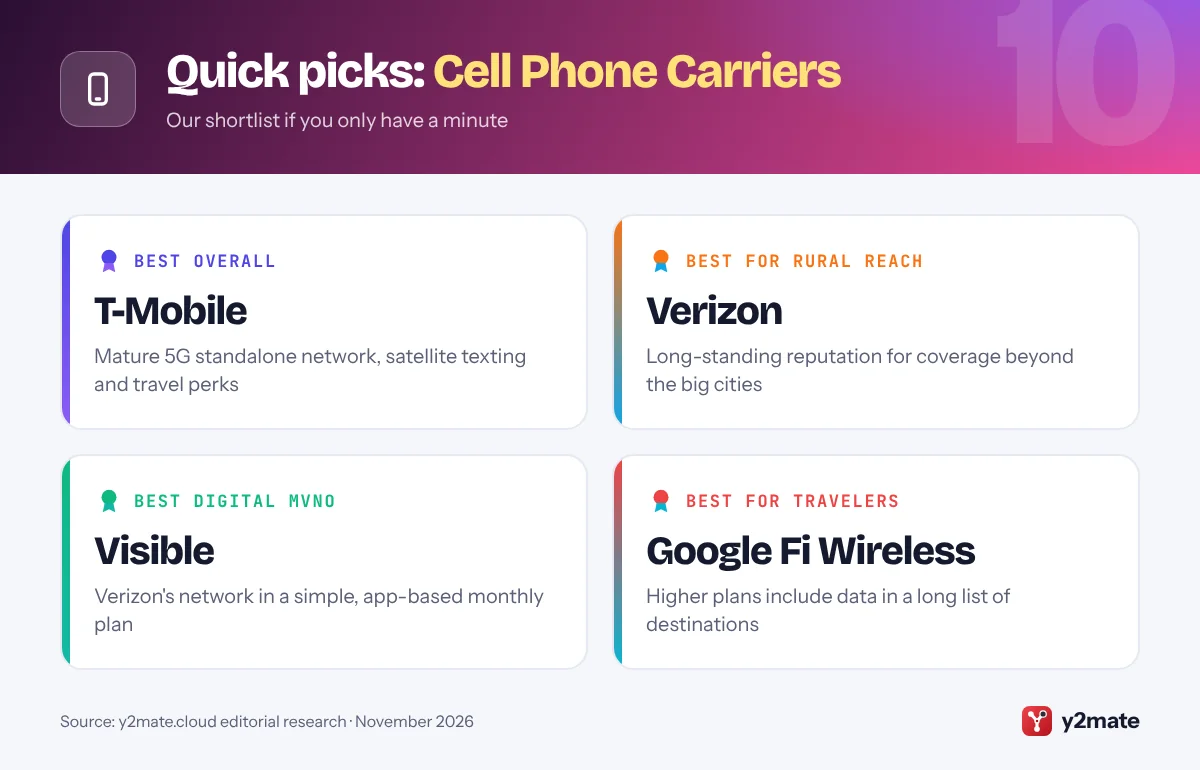
The best cell phone carriers in the USA in 2026 are T-Mobile for 5G coverage and extras, Verizon for dependable nationwide reach, and AT&T for a strong all-round network with nationwide 5G standalone. If you want to pay less without giving up those networks, MVNOs such as Visible, Mint Mobile, Cricket Wireless and Metro by T-Mobile run on the same towers with simpler, mostly prepaid plans.
An MVNO (mobile virtual network operator) is a carrier that does not own a cell network. It buys capacity from one of the big three and sells its own plans, often online only. The market shifted a lot in 2025: T-Mobile bought UScellular’s wireless business, and EchoStar agreed to sell most of its spectrum to AT&T and SpaceX, so Boost Mobile customers now connect through AT&T’s radio network.
This list ranks ten carriers that matter for everyday buyers, explains which network each one uses, and shows who should pick it and who should skip it. It is written for anyone switching carriers, buying a new phone or trying to trim a family phone bill without losing coverage.
How we ranked this list
We compared publicly documented information for each carrier: coverage as shown on its official map and on the FCC’s National Broadband Map, 5G and 5G standalone (5G SA) availability, eSIM support, Wi-Fi calling, international roaming options, the choice between postpaid and prepaid plans, and how you can reach customer support. We also weighed widely reported customer feedback and recent ownership and network changes.
We did not run our own speed or coverage tests, and we do not list prices or plan allowances because they change often and depend on promotions. Always check a carrier’s live coverage map for your home and work addresses before you switch.
The Top 10 Cell Phone Carriers
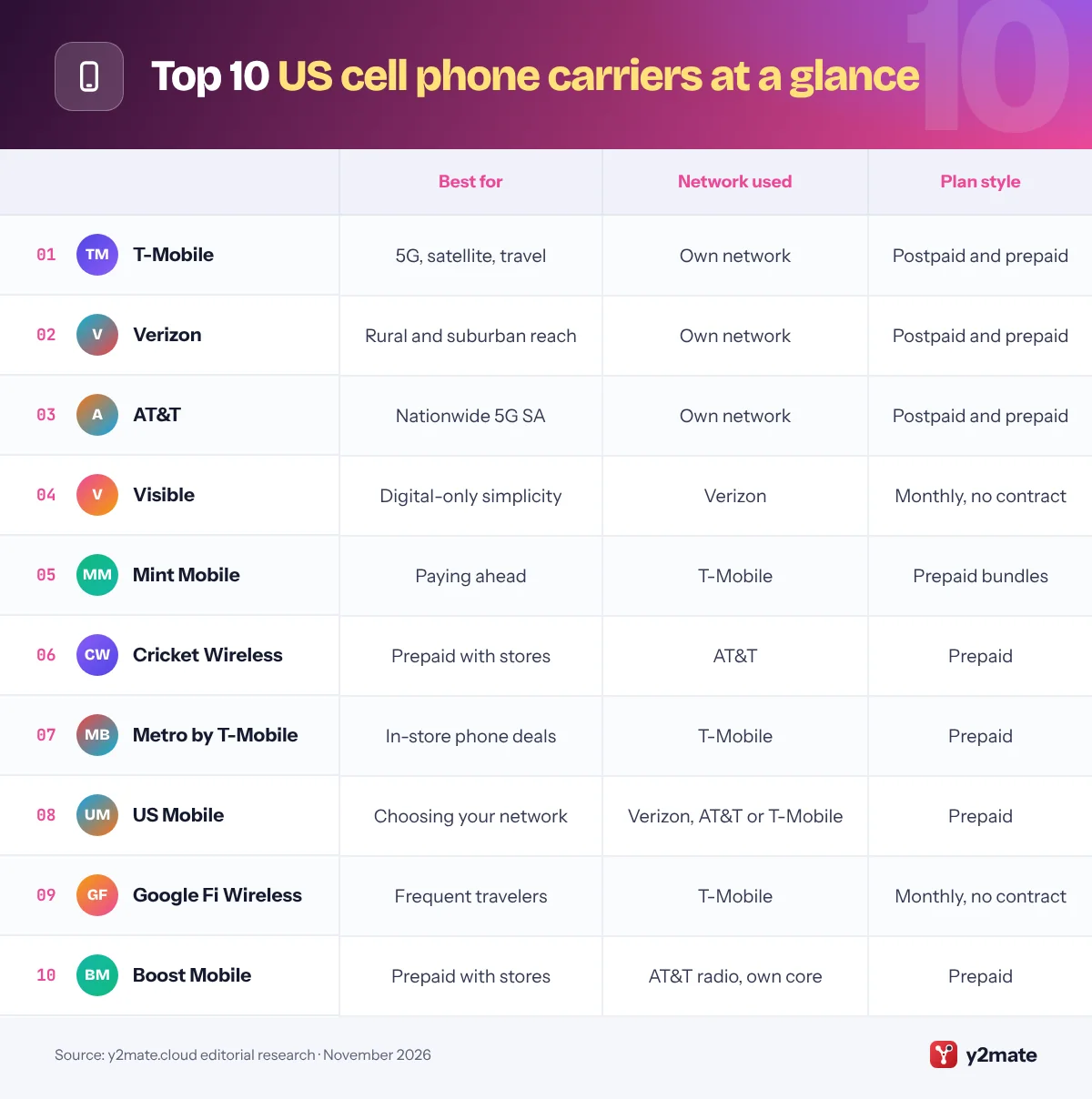
1. T-Mobile
Best for: 5G coverage, satellite texting and travel perks
T-Mobile runs one of the three national networks and has the most mature 5G setup of the big carriers. It launched a nationwide 5G standalone (5G SA) network back in 2020, which means its 5G runs on a dedicated 5G core rather than leaning on 4G LTE. In August 2025 it completed its purchase of UScellular’s wireless operations, adding customers, stores and spectrum, and it has been moving those customers onto T-Mobile plans and systems.
Its extras are a big draw. T-Satellite, built with SpaceX’s Starlink, lets compatible phones send texts in many places with no cell signal; it is included on some plans and sold as an add-on to others, including to customers of other carriers. Many postpaid plans also include data and texting in a long list of countries, which suits frequent travelers. eSIM, Wi-Fi calling, postpaid and prepaid plans are all available, and T-Mobile also owns Metro by T-Mobile and Mint Mobile.
The trade-offs: in some rural areas Verizon or AT&T may still reach places T-Mobile does not, so check the map for the roads you drive, and the best perks sit on its higher plan tiers.
Official site: T-Mobile
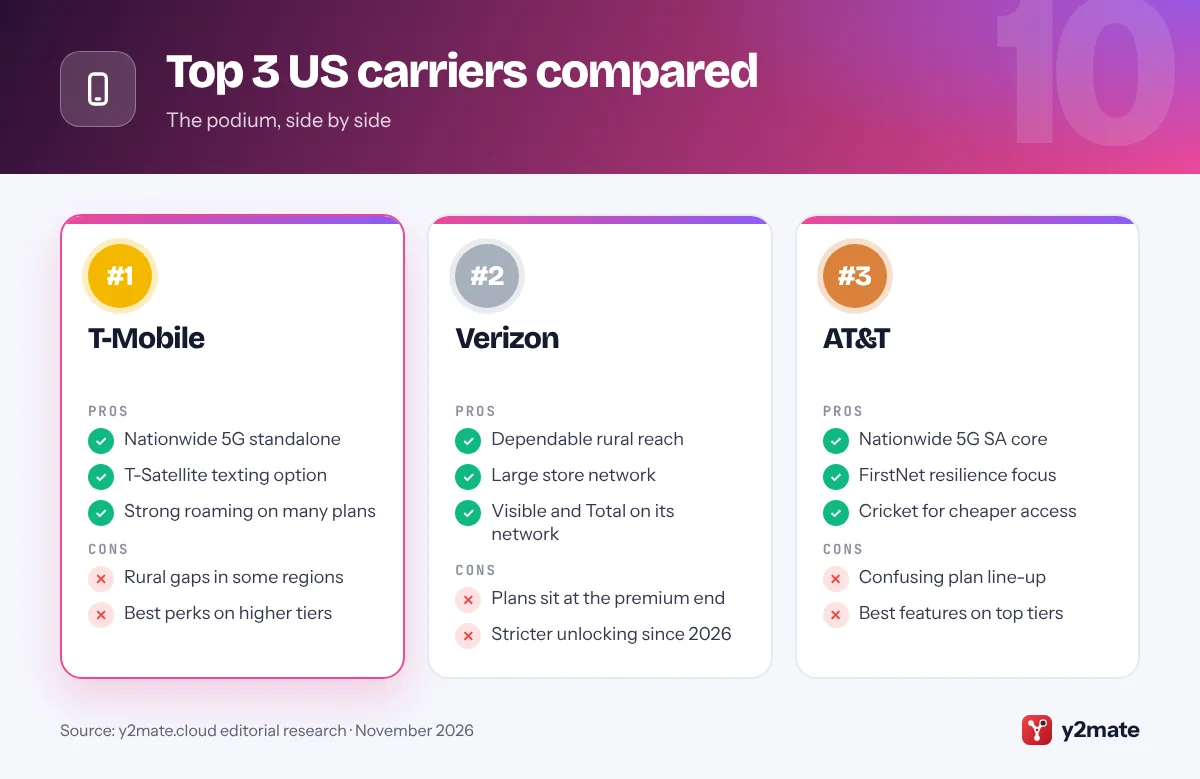
- Nationwide 5G standalone network
- T-Satellite texting option
- Strong travel features on many plans
- Rural gaps in some regions
- Best perks on higher tiers
2. Verizon
Best for: dependable coverage in cities and rural areas
Verizon has long had a reputation for dependable coverage, especially across rural and suburban America, built on a very large 4G LTE footprint. Its faster 5G Ultra Wideband service, which uses C-band and millimeter-wave spectrum, covers many cities and suburbs, while its nationwide 5G fills in elsewhere. Verizon has also confirmed a nationwide 5G standalone core, although the full benefits depend on your phone supporting it and on Verizon moving traffic onto it in your area.
Verizon supports eSIM and Wi-Fi calling, offers postpaid and prepaid plans, and has a large network of stores for in-person help. It owns several value brands, including Visible, Total Wireless and Straight Talk, so you can stay on its network for less if you are willing to give up some perks.
Two things to watch. Verizon’s plans tend to sit at the premium end of the market, and its phone unlocking rules changed in January 2026, when the FCC waived the condition that required it to unlock phones automatically after 60 days. If you may want to switch carriers later, read Verizon’s current unlocking policy before you buy a phone from it.
Official site: Verizon
- Dependable rural and suburban reach
- Large store network
- Value brands on the same network
- Plans sit at the premium end
- Phone unlocking now stricter
3. AT&T
Best for: nationwide 5G SA and first-responder backing
AT&T runs the third national network and announced in late 2025 that its 5G standalone core was deployed nationwide. That lets compatible phones use 5G without leaning on a 4G core. AT&T also agreed in 2025 to buy a large block of spectrum from EchoStar, and since November 2025 it has carried Boost Mobile’s customer traffic on its radio network.
AT&T builds and runs FirstNet, the nationwide network for police, fire and EMS crews, which gives the company a strong focus on resilience. For consumers it offers postpaid and prepaid plans, eSIM, Wi-Fi calling, international day passes and a wide store network, and it owns Cricket Wireless, one of the biggest prepaid brands in the country.
AT&T’s coverage is broad, but like every carrier it has gaps, so compare its map with Verizon’s and T-Mobile’s for the places you go. Its plan line-up and add-ons can be confusing, and the best features usually sit on its higher tiers. If you want AT&T’s network for less, look at Cricket Wireless or an MVNO that uses AT&T.
Official site: AT&T
- Nationwide 5G standalone core
- FirstNet resilience focus
- Owns Cricket for cheaper access
- Plan line-up can be confusing
- Best features on higher tiers
4. Visible
Best for: low-fuss digital service on Verizon
Visible is Verizon’s own digital-only carrier. It runs on Verizon’s network, and its higher-tier plans add access to Verizon’s faster 5G Ultra Wideband service where available, so you get much of Verizon’s coverage in a simpler package. Everything happens in the Visible app or on its website: you sign up, activate an eSIM in minutes and manage your line without visiting a store.
Plans are month to month with no annual contract, and Wi-Fi calling, hotspot use and unlimited talk and text are part of the service. Higher tiers add calling and roaming in Mexico and Canada, and Visible has added travel passes for trips further afield. It is a natural fit for single users and couples who want Verizon coverage without Verizon’s own plans.
The catch is support and priority. Visible has no traditional phone support line, so help comes through chat and social channels, which frustrates some customers. On its base plan, data can be slowed ahead of Verizon’s own customers when the network is busy. If you need in-store help or more family account tools, Verizon itself or Total Wireless may suit you better.
Official site: Visible
- Runs on Verizon's network
- Fast eSIM sign-up in the app
- No annual contract
- No phone support line
- Base plan deprioritized when busy
5. Mint Mobile
Best for: paying ahead for T-Mobile coverage
Mint Mobile is a prepaid MVNO on T-Mobile’s network, and T-Mobile has owned it since 2024. Its signature idea is buying service in advance in multi-month bundles rather than month by month, which suits people who are happy to commit for a while.
Because it uses T-Mobile’s network, Mint customers get T-Mobile’s 4G and 5G coverage. Mint supports eSIM activation through its app, Wi-Fi calling and hotspot use, and it sells SIM kits through major retailers as well as online. In 2026 it also launched a bundle that pairs its mobile service with home internet.
There are limits. Mint has no stores of its own, support is mainly online, and like most MVNOs its data can be deprioritized behind T-Mobile’s own postpaid customers when a cell site is busy. Its best value comes from paying for several months at once, which makes it less flexible if you think you may switch soon. If you live where T-Mobile is strong, Mint is one of the simplest ways to use that network for less.
Official site: Mint Mobile
- Uses T-Mobile's 5G network
- Easy eSIM setup in the app
- Simple prepaid bundles
- No stores of its own
- Best value needs paying ahead
6. Cricket Wireless
Best for: prepaid customers who want real stores
Cricket Wireless is AT&T’s prepaid brand and one of the largest prepaid carriers in the USA. It runs on AT&T’s network, including 5G on compatible phones, and it has a large network of Cricket stores and authorized dealers. That makes it a good pick if you want to walk into a shop to buy a phone, sort out a problem or pay in person.
Plans are month to month with no annual contract, and Cricket supports eSIM activation on compatible unlocked phones, Wi-Fi calling and multi-line family accounts. Some plans add extras for calling or using your phone in Mexico and Canada. Because it is owned by AT&T, Cricket is often the easiest way to get AT&T coverage without a postpaid account.
As with other prepaid brands, Cricket’s data can be slowed behind AT&T’s own customers when the network is busy, and features such as hotspot use depend on the plan. Store experiences vary because many locations are run by independent dealers. If you want AT&T’s coverage with the option of face-to-face help, Cricket is the strongest prepaid choice on that network.
Official site: Cricket Wireless
- AT&T coverage without a contract
- Large store and dealer network
- Family multi-line options
- Data can be deprioritized
- Store quality varies by dealer
7. Metro by T-Mobile
Best for: in-store prepaid phone deals
Metro by T-Mobile is T-Mobile’s main prepaid brand, sold through a large network of stores and dealers across the country. It runs on T-Mobile’s network, so customers get the same 4G and 5G coverage map as T-Mobile itself, and it is aimed squarely at people who want a new phone and service without a credit check or annual contract.
Metro is known for in-store offers on phones for customers who bring their number from another carrier, and some of its plans bundle extra perks. It supports eSIM, Wi-Fi calling and multi-line accounts, and because the brand belongs to T-Mobile, it benefits from the same network investment as T-Mobile’s own customers.
The downsides mirror Cricket’s. Data on Metro can be deprioritized behind T-Mobile’s postpaid customers, the best phone deals usually require switching your number in, and the quality of help depends on the store you visit. If you want T-Mobile coverage, a shop down the street and a discounted phone, Metro is worth a look; if you are comfortable doing everything online, Mint Mobile is usually simpler.
Official site: Metro by T-Mobile
- T-Mobile 4G and 5G coverage
- Large store network
- Phone offers for switchers
- Data can be deprioritized
- Best deals need a number port
8. US Mobile
Best for: choosing between all three networks
US Mobile is an independent MVNO with an unusual twist: you choose which of the three national networks your line uses. It brands them Warp (Verizon), Dark Star (AT&T) and Light Speed (T-Mobile), and you can move a line between them later if coverage disappoints, instead of switching carriers and porting your number.
It also sells a multi-network add-on that lets a phone connect to more than one of those networks and use whichever signal is stronger, which can help people who travel through patchy rural areas. Activation is mostly by eSIM through its app, Wi-Fi calling is supported on compatible phones, and plans are prepaid with no annual contract.
US Mobile is best for confident, tech-savvy users. Support is online, there are no stores, and features and plan details can differ between its three networks, so read the details for the network you pick. As an MVNO, its data can also be deprioritized during congestion. If you are not sure which network is best where you live, being able to switch networks without changing carriers is a real advantage.
Official site: US Mobile
- Pick Verizon, AT&T or T-Mobile
- Switch networks without porting
- Multi-network add-on
- Online-only support
- Features vary by network
9. Google Fi Wireless
Best for: frequent travelers and Pixel owners
Google Fi Wireless is Google’s own carrier, and in the USA it runs on T-Mobile’s network. It is one of the most travel-friendly options on this list: its higher plans include data use in a long list of destinations at no extra charge, and you keep using your normal number and texts abroad, which makes it a favorite with people who travel often.
Fi is designed to work closely with Google Pixel phones and also supports iPhones and many other Android devices, with eSIM activation on compatible models. Wi-Fi calling and simple family plan management are part of the package, and you can handle everything from the Fi app.
The trade-offs: there are no Fi stores, support is online and by phone rather than in person, and because Fi uses T-Mobile, places where T-Mobile is weak will also be weak on Fi. Some features work best, or only, on Pixel phones. If you spend a lot of time abroad and T-Mobile covers your home area well, Fi deserves a close look.
Official site: Google Fi Wireless
- Strong international data options
- Deep Pixel integration
- Easy app-based management
- Coverage tied to T-Mobile
- Some features Pixel-only
10. Boost Mobile
Best for: prepaid users who like its stores and app
Boost Mobile has changed more than any other brand on this list. Its owner, EchoStar, spent years building a fourth national 5G network, then in 2025, after an FCC inquiry into how it was using its airwaves, agreed to sell most of its spectrum to AT&T and SpaceX. Boost now describes itself as a hybrid mobile network operator: it keeps its own cloud-based 5G core, which handles your line and plan, while the radio network your phone connects to belongs to AT&T. EchoStar says it finished moving all customer traffic onto AT&T’s network in November 2025.
For customers, that means Boost coverage now largely follows AT&T’s map rather than EchoStar’s old network. Boost sells prepaid plans through its own stores, dealers and online, and supports eSIM and Wi-Fi calling on compatible phones. As part of the SpaceX deal, EchoStar also agreed that Boost customers will get access to Starlink’s next-generation direct-to-cell satellite service once it is available.
Boost is ranked last because so much is still settling: some help pages have lagged behind the network change, and the brand’s direction depends on EchoStar’s next steps. If AT&T covers your area and you like Boost’s plans, it is a reasonable choice; otherwise the more established brands above are safer bets.
Official site: Boost Mobile
- Runs on AT&T's radio network
- Own 5G core and app
- Planned Starlink satellite access
- Brand still in transition
- Some help pages out of date
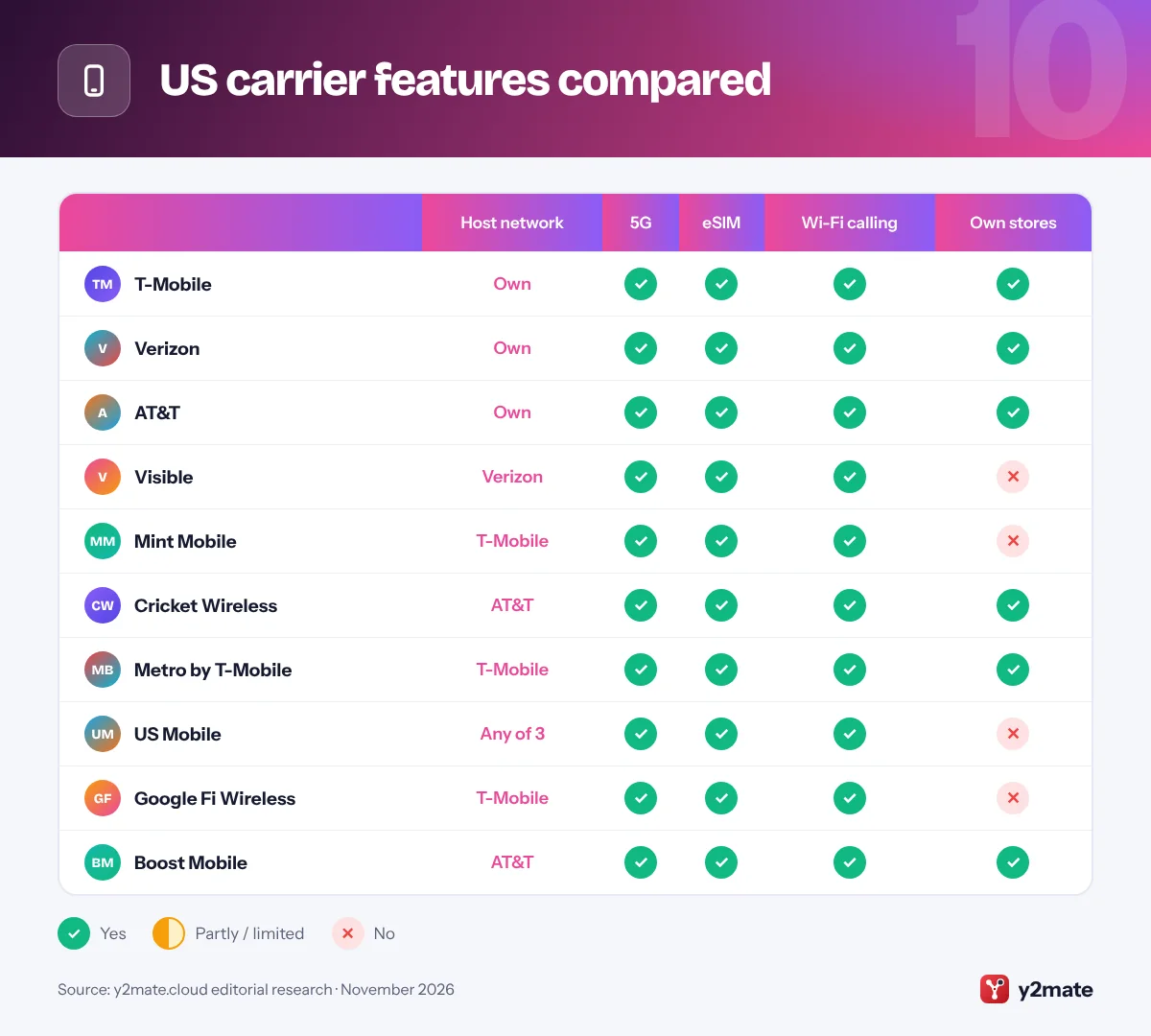
US carrier features compared
How to choose between cell phone carriers in the USA
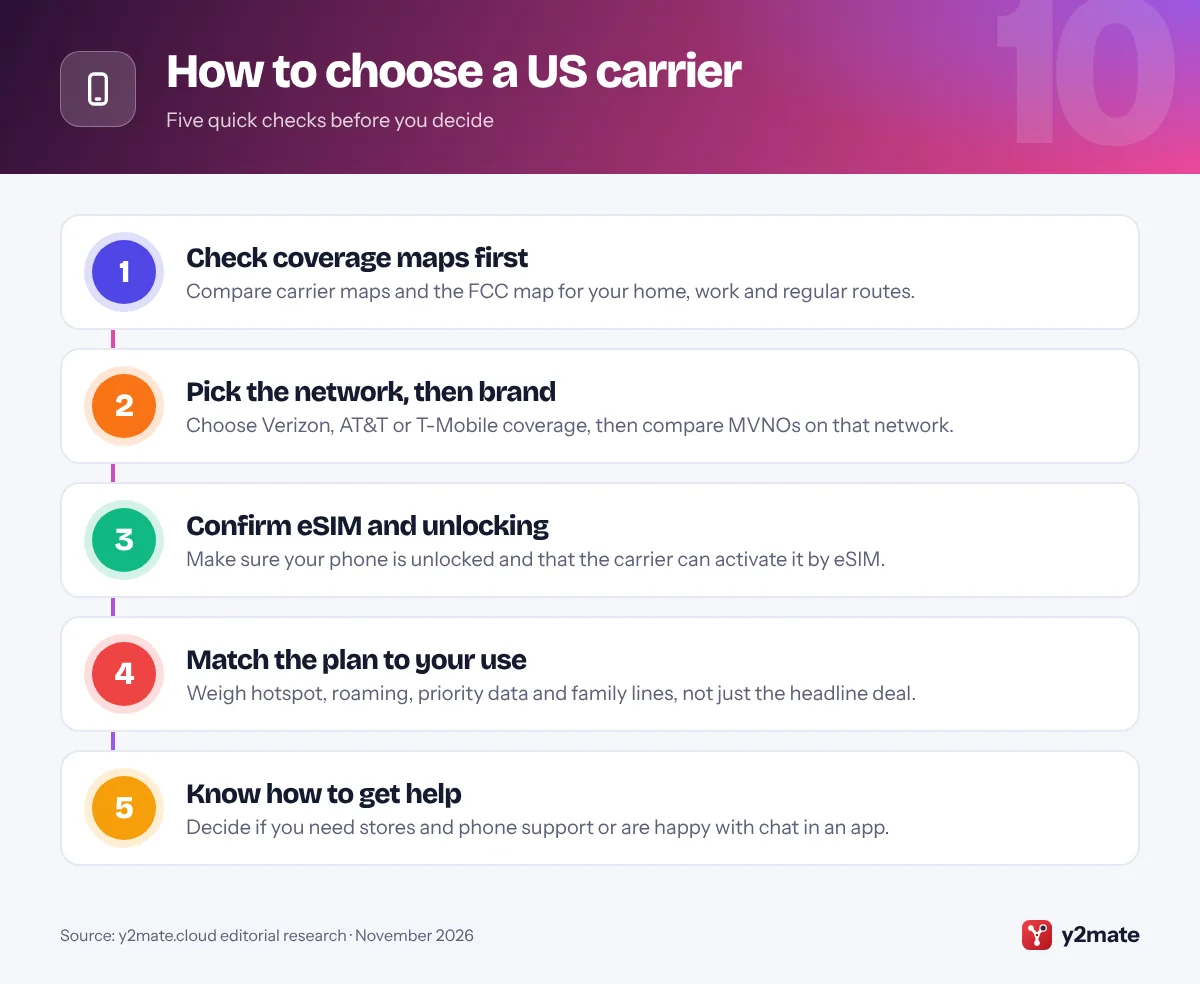
Start with coverage, because no plan is good value if your phone has no signal at home. Every carrier publishes a coverage map, and the FCC’s National Broadband Map shows each provider’s reported outdoor and in-vehicle 4G and 5G coverage at any address, so compare both for the places you spend the most time. Indoor signal can be weaker than any map suggests.
Network first, brand second
All the cell phone carriers in the USA on this list use one of three networks. Once you know which network works best where you live, compare the brands on it:
- Verizon network: Verizon, Visible, Total Wireless and US Mobile’s Warp.
- AT&T network: AT&T, Cricket Wireless, Boost Mobile and US Mobile’s Dark Star.
- T-Mobile network: T-Mobile, Metro by T-Mobile, Mint Mobile, Google Fi Wireless and US Mobile’s Light Speed.
MVNOs often cost less because they skip stores and extras, but their data may be deprioritized when a cell site is busy.
Check eSIM, unlocking and support
iPhones sold in the USA since the iPhone 14 use eSIM only, so confirm a carrier supports eSIM activation for your model. If your phone came from a carrier, check that it is unlocked before you switch. FCC rules let you keep your number when you change carriers, and the FCC has adopted rules that require carriers to verify customers before swapping a SIM or moving a number, to fight fraud. If a dispute goes nowhere, you can file a free complaint with the FCC.
Frequently asked questions
What is the best cell phone carrier in the USA?
There is no single best carrier for everyone, because coverage varies by address. Overall, T-Mobile leads on 5G and extras, Verizon has a strong reputation for rural and suburban reach, and AT&T offers a well-rounded network with nationwide 5G standalone. Check the carrier maps and the FCC's National Broadband Map for your area, then consider a cheaper MVNO that runs on the network that works best there.
What is an MVNO?
An MVNO, or mobile virtual network operator, is a carrier that does not own cell towers. It buys access from a network owner such as Verizon, AT&T or T-Mobile and sells its own plans. Visible, Mint Mobile, Cricket Wireless and Google Fi Wireless are examples. You usually get the host network's coverage, but your data may be slowed before the host's own customers when the network is busy.
What network does Boost Mobile use now?
Boost Mobile, owned by EchoStar, now runs its customers on AT&T's radio network while keeping its own 5G core for managing lines and plans. EchoStar says it moved all customer traffic to AT&T's network in November 2025, after agreeing to sell most of its spectrum to AT&T and SpaceX. In practice, Boost coverage now follows AT&T's coverage map rather than EchoStar's former network.
What happened to UScellular?
T-Mobile bought UScellular's wireless operations, including its customers, stores and part of its spectrum, and completed the deal in August 2025. UScellular customers have been moving onto T-Mobile plans, accounts and systems, and most UScellular phones already work on T-Mobile's network. If you were a UScellular customer, check T-Mobile's transition pages for the steps that apply to your account.
Do all US carriers support eSIM?
All ten carriers on this list support eSIM activation on compatible phones, though the exact steps differ. That matters because iPhones sold in the USA since the iPhone 14 have no physical SIM tray. Before switching, make sure your phone is unlocked, run the carrier's compatibility check, and have your account number and transfer PIN ready so your number moves quickly and securely.
Final verdict
For most people, choosing between cell phone carriers in the USA comes down to the network that covers your home and daily routes: T-Mobile for 5G and extras, Verizon for dependable reach, or AT&T for a strong all-round network. Once you know which network works for you, an MVNO such as Visible, Mint Mobile, Cricket Wireless or US Mobile can deliver that coverage with simpler, no-contract plans.
The market is still settling after the UScellular and EchoStar deals, so check each carrier’s current coverage map and policies before you switch, and remember the FCC’s free complaint process if anything goes wrong.
Sources and further reading
- FCC National Broadband Map: The FCC's map of each provider's reported 4G and 5G mobile coverage at any US address, with tools to challenge errors.
- Keeping your number when switching: FCC consumer guide explaining your right to keep your phone number when you move to a new carrier.
- FCC Consumer Complaint Center: Where to file a free complaint with the FCC if a carrier will not resolve a billing, service or number transfer problem.
- FCC SIM-swap fraud rules: Federal Register text of the FCC's rules requiring carriers to protect customers from SIM-swap and port-out fraud.

Leave a Reply