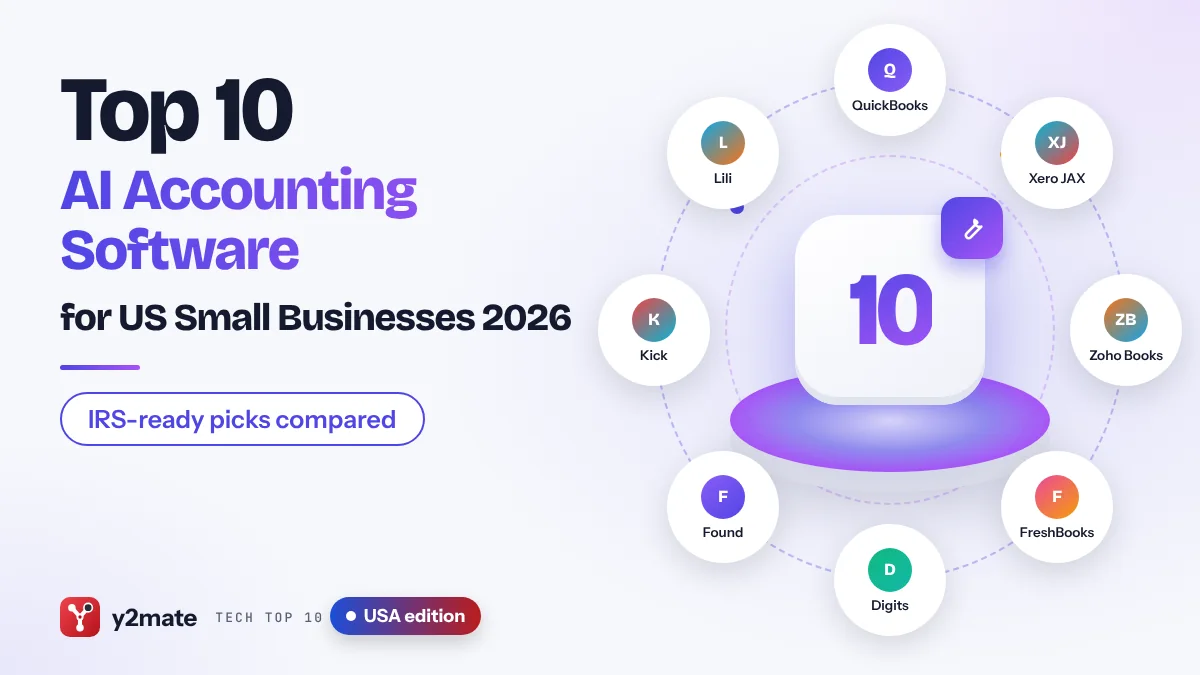
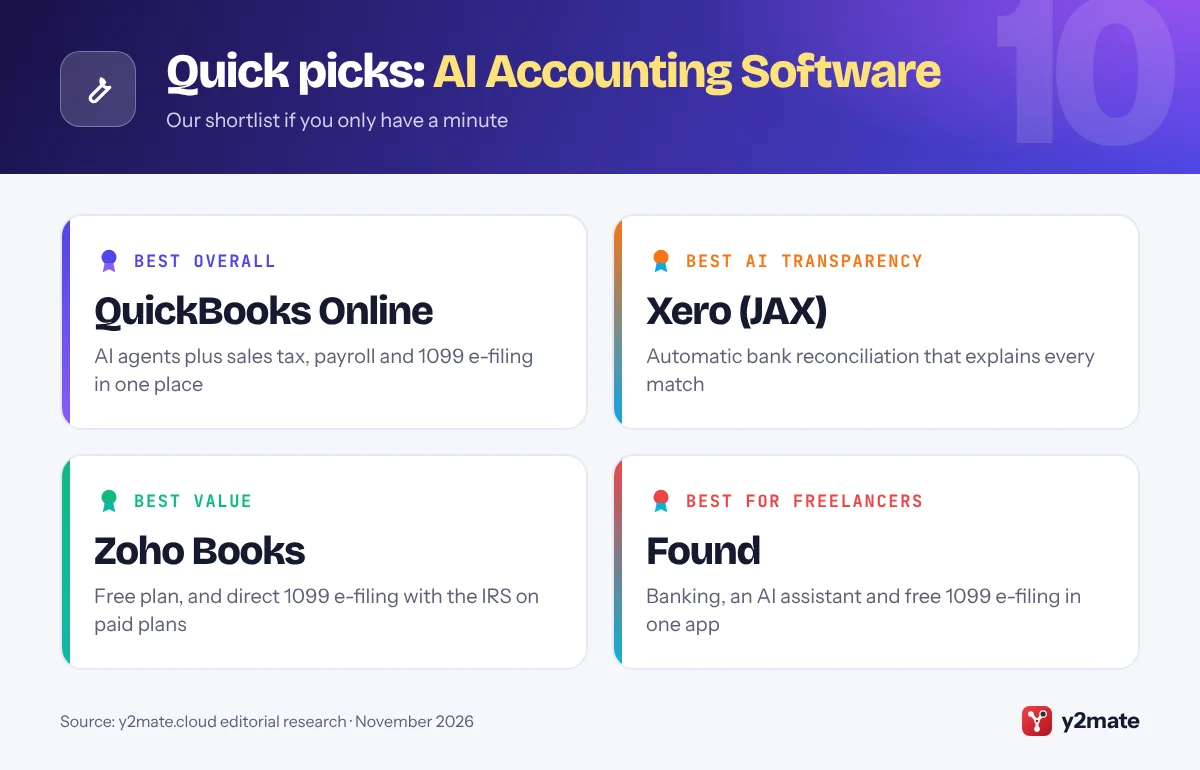
- For most US small businesses, QuickBooks Online is the safest choice of AI accounting software because its AI agents, sales tax tools, payroll and 1099 e-filing sit in one platform that most accountants know.
- The IRS retired its FIRE system in November 2026, so from January 2027 information returns such as Forms 1099 must be e-filed through IRIS, either directly or from compatible software.
- For payments made after December 31, 2025, the reporting threshold for Forms 1099-NEC and 1099-MISC rose from $600 to $2,000.
- AI features such as auto-categorization, bank-reconciliation matching and sales tax checks still need human review, and none of them replace a CPA or enrolled agent.
- Free plans exist from Zoho Books, Found, Kick and Wave, but the most capable AI tools usually sit on paid plans.
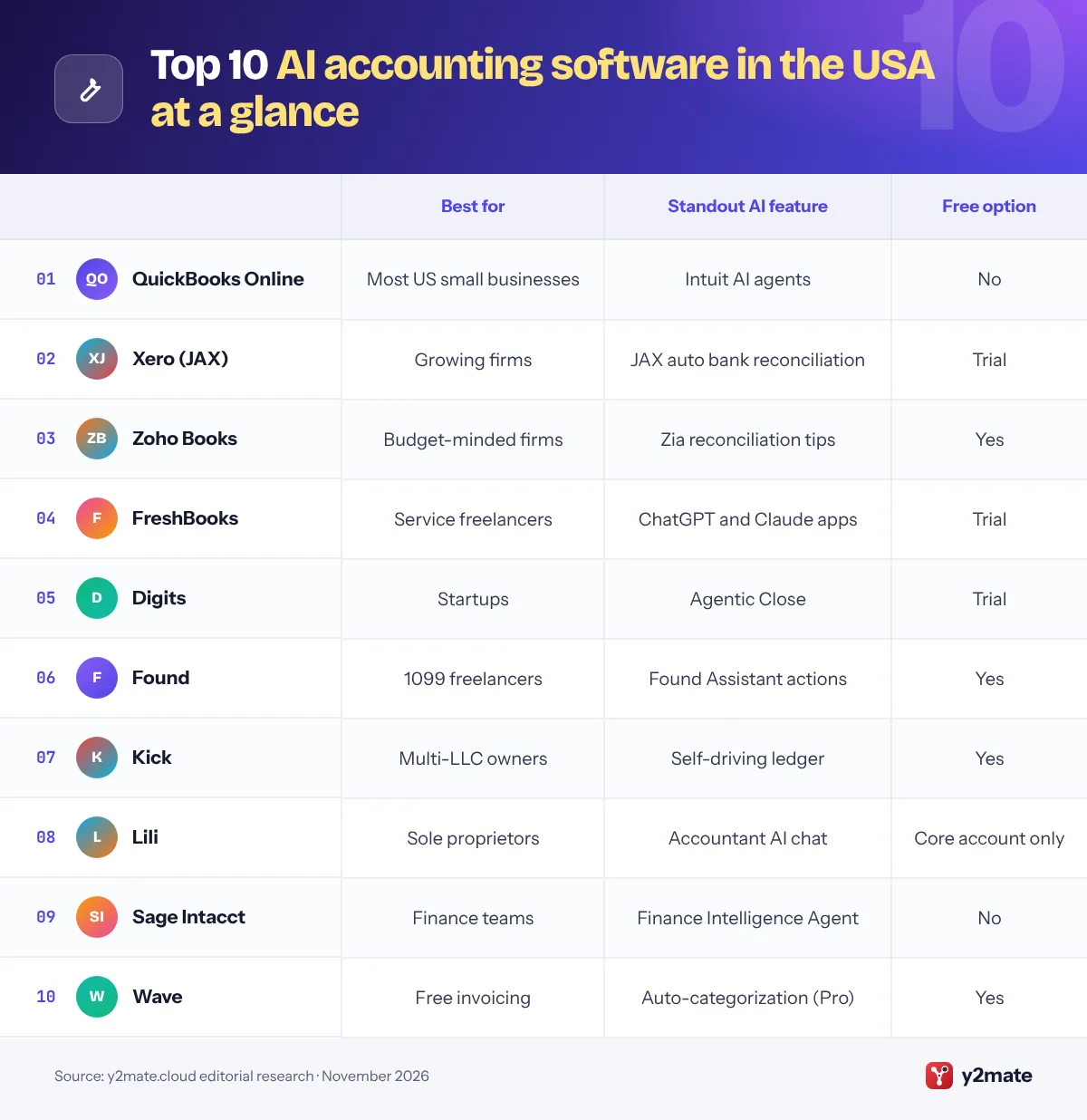
The best AI accounting software for most US small businesses in 2026 is QuickBooks Online, whose Intuit AI agents categorize transactions and flag sales tax problems, with Xero and Zoho Books as strong alternatives. Freelancers may be better served by all-in-one apps such as Found, Lili or FreshBooks, while startups should look at AI-native ledgers like Digits and Kick.
Here, AI accounting means bookkeeping software that uses machine learning or generative AI to suggest categories, match bank transactions, read receipts or answer questions about your numbers. The US angle matters: sales tax differs by state, payroll taxes apply at several levels, and the IRS now takes all electronic Forms 1099 through its IRIS system.
This list is for owners of US small businesses, LLCs and sole proprietorships, and for 1099 freelancers. Every product is sold in the US today, and we say who should not use each one.
How we ranked this list
We did not carry out hands-on testing. The ranking is based on publicly documented AI features, local tax compliance (IRS e-filing of 1099s through IRIS, multistate sales tax and payroll support), suitability for small firms and sole proprietors, and official documentation and widely reported user feedback, including vendor help centers and irs.gov guidance.
We favored AI that works inside the ledger, where its suggestions can be checked, and we flag features still in beta. AI tools often differ by plan, so confirm what yours includes.
The Top 10 AI Accounting Software
1. QuickBooks Online
Best for: most US small businesses and their accountants
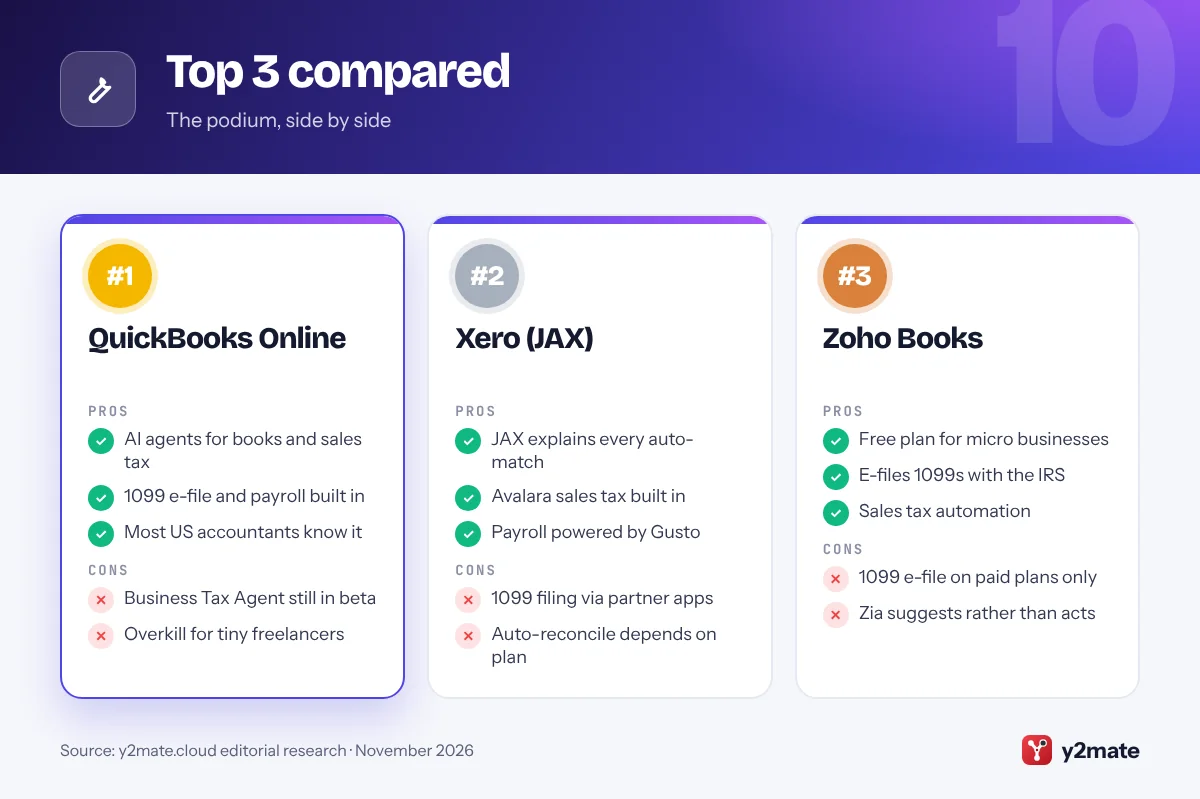
QuickBooks Online is the accounting platform most US bookkeepers and CPAs already know, and Intuit has rebuilt it around AI under the Intuit Intelligence name. Its Accounting Agent suggests categories, matches bank transactions and flags anomalies, while other agents cover payments, customers, payroll and sales tax. The Sales Tax Agent is designed to help you charge the right sales tax and spot issues before you file, and a Business Tax Agent, still in beta, suggests deductions you may have missed.
The US compliance plumbing is the real draw. QuickBooks calculates sales tax, runs payroll in the same system and can e-file federal Forms 1099-NEC and 1099-MISC from data already in your books, although state 1099 filings are separate.
Intuit’s AI features are not available in QuickBooks Self-Employed, and beta features have limited availability. Skip it if you only send a handful of invoices a year.
Official site: QuickBooks Online
- AI agents for books, payroll and sales tax
- The ledger most US accountants know
- 1099 e-filing built in
- Business Tax Agent still in beta
- Overkill for very small freelancers
2. Xero (JAX)
Best for: growing firms that want AI with an audit trail
Xero calls its AI platform JAX. In the US, JAX’s Auto Bank Reconciliation matches high-confidence transactions to bank feeds automatically and tells you why it made each match, leaving exceptions for a person to handle. Smart Document Capture reads bills and receipts straight into Xero, and JAX flags duplicates, missing documents and anomalies. In August 2026 Xero also announced integrations that bring live Xero data into Microsoft 365, Claude and ChatGPT.
For US tax, Xero’s automatic sales tax is powered by Avalara and calculates rates from location and item details. Xero generates 1099-NEC and 1099-MISC reports, but filing runs through e-filing partner apps. Xero Payroll, powered by Gusto, launched for eligible US customers in August 2026.
Xero suits owners who value a clean ledger and work with an accountant who uses it. If your CPA lives in QuickBooks, or you want built-in 1099 e-filing, look elsewhere. Some JAX automation depends on your plan.
Official site: Xero (JAX)
- JAX explains every automatic match
- Avalara-powered sales tax
- Payroll powered by Gusto
- 1099 filing needs a partner app
- Auto-reconcile depends on plan
3. Zoho Books
Best for: budget-minded firms that want 1099 e-filing
Zoho Books is the value pick, and it has quietly added some of the most useful US compliance features on this list. Since January 2026 it can generate and e-file Forms 1099 directly with the IRS after you review them, and it tracks payments to 1099 vendors and helps you collect W-9 forms. In May 2026 Zoho added sales tax automation that determines and applies the correct tax to transactions.
Its AI assistant, Zia, suggests categories, accounts and vendors during bank reconciliation based on your past bookkeeping, and you review every recommendation. Zoho Books can also be linked to outside AI agents through MCP, the open standard many assistants use to connect to apps.
There is a free plan for solopreneurs and micro businesses, while 1099 e-filing and sales tax tracking sit on paid plans. It suits firms already using Zoho CRM or Inventory. If your accountant only supports QuickBooks, or you need payroll in the same login, check fit first.
Official site: Zoho Books
- E-files 1099s directly with the IRS
- Free plan for micro businesses
- Zia reconciliation suggestions
- 1099 e-filing needs a paid plan
- Zia suggests rather than acts
4. FreshBooks
Best for: service freelancers who live in their invoices
FreshBooks started as invoicing software for freelancers and service businesses, and that is still where it shines: estimates, proposals, time tracking and online payments. Rather than building one big in-house agent, FreshBooks connects your data to AI tools you may already use. In September 2026 it announced a connector for Anthropic’s Claude, and on November 19, 2026 it joined OpenAI’s ChatGPT for Accounting launch with a free, read-only FreshBooks app that answers questions about invoices, expenses and cash flow but cannot change anything in your account.
For the bookkeeping itself, FreshBooks partnered with Kick in January 2026 to offer US users automated categorization and reconciliation of transactions and receipts, with a human bookkeeper review. FreshBooks also offers payroll.
FreshBooks suits consultants, agencies and creatives who bill for their time. Product sellers juggling inventory and sales tax in many states should compare its tax tools with QuickBooks or Xero before committing.
Official site: FreshBooks
- Excellent invoicing and time tracking
- Read-only ChatGPT and Claude apps
- Optional Kick bookkeeping service
- Most AI lives in outside apps
- Aimed at service businesses
5. Digits
Best for: startups that want an AI-native ledger
Digits calls itself the first AI-native general ledger, built from scratch for business owners and accountants rather than retrofitted with a chatbot. It categorizes transactions continuously, and its Agentic Close product, launched in June 2026, aims to turn month-end close into an ongoing process that collects, books, reconciles and reports as activity happens. Ask Digits is the built-in assistant for plain-English questions, and recent additions include budgets versus actuals and multi-entity support.
In October 2026 Digits launched Write MCP, which lets a customer’s own AI agents post changes to the ledger, with any change that touches a locked period held for review. That is a thoughtful safeguard as more businesses let agents act on their books.
Digits suits venture-backed startups and tech-savvy owners whose accountant supports it. It is less of a one-stop shop for US compliance than QuickBooks or Xero, so plan how payroll, sales tax and 1099 filing will connect. Someone still needs to review the exceptions it raises.
Official site: Digits
- Built AI-first from scratch
- Locked periods guard against agents
- Multi-entity and budgets
- Plan payroll and 1099s separately
- Newer than mainstream ledgers
6. Found
Best for: 1099 freelancers who want banking and books
Found combines a business checking account with bookkeeping, invoicing and tax tools aimed at self-employed people and small LLCs. Found is a financial technology company, not a bank, and its banking services come from a partner bank. Transactions are categorized as they happen, and the built-in tax tools estimate what you owe, track write-offs and help you set money aside in Pockets, Found’s sub-accounts.
Found Assistant is its AI helper. Beyond answering questions about your account, it can create a manual bookkeeping entry, find uncategorized expenses, upload receipts, move money between Pockets and draft invoices. The free Found plan also lets you pay contractors, collect W-9s and e-file 1099s.
Found is ideal for a one-person business that wants everything in one app. It is not a full accounting system for a company with employees, inventory or multistate sales tax, and Found says its assistant does not provide tax or legal advice, so keep a tax professional for your return.
Official site: Found
- Banking, books and taxes together
- AI assistant can take actions
- Free plan e-files 1099s
- You must bank with Found
- Too light for growing companies
7. Kick
Best for: owners juggling several LLCs
Kick describes itself as self-driving accounting: an agentic ledger that categorizes and reconciles transactions so the owner moves from doing the books to reviewing them. It handles multiple entities in one place, which suits people who run several LLCs or a holding company, and it offers an API, MCP access and an agent builder for connecting your own AI tools.
Kick is also the engine behind FreshBooks’ US bookkeeping service. When the two companies partnered in January 2026, they described automated categorization and reconciliation of transactions, receipts and documents, backed by a human bookkeeper review. That mix of automation and people suits small firms that cannot hire a full-time bookkeeper.
Kick is newer than the big platforms, so check that your accountant is comfortable with it, and confirm how payroll and sales tax filing will fit. You can start free and test it on a month of real transactions before committing.
Official site: Kick
- Multi-entity books in one place
- API, MCP and agent builder
- Free to start
- Smaller ecosystem than leaders
- Check accountant support first
8. Lili
Best for: sole proprietors who want an AI tax helper
Lili is a business banking app with bookkeeping and tax features built in, designed for freelancers and small businesses. Transactions are categorized automatically, profit and loss statements and expense summaries are generated on demand, and a Tax Bucket lets you set money aside automatically for tax payments.
Its Accountant AI is a chat assistant that answers accounting questions using your Lili banking and bookkeeping data, combined with general tax and industry information. It is available on the paid Smart and Premium plans. In June 2026 Lili also launched an MCP server that lets accountants connect compatible AI assistants to their clients’ Lili banking data.
Lili suits owners who want banking and bookkeeping in one app and a quick way to ask questions. Lili states that it is not a tax preparer and does not provide tax, legal or accounting advice, so confirm anything important with a CPA or enrolled agent. Firms with employees and inventory will outgrow it.
Official site: Lili
- Banking and bookkeeping in one app
- Accountant AI chat on paid plans
- Automatic tax set-asides
- AI only on paid plans
- Not a tax preparer
9. Sage Intacct
Best for: growing firms with an in-house finance team
Sage Intacct is a step up from small business bookkeeping: cloud financial management for companies with a finance team, several entities or complex reporting needs. Its AI plans are ambitious. Sage Copilot is built in, and the Finance Intelligence Agent, which answers natural-language questions using your financial data, is offered to US customers as a phased early-adopter feature. In November 2026 Sage set out plans for AI Workspaces, starting with an accounts payable workspace in limited rollout to selected customers, and its Sage Agent Marketplace is already available.
For US firms, the appeal is control: multi-entity accounting, audit trails and detailed reporting an outside CPA can rely on. Sage says availability of its AI workspaces and agents varies by capability and market.
This is not software for sole proprietors or a two-person shop. It is usually sold through partners, there is no free plan, and several headline AI features are still early. Consider it once you have outgrown QuickBooks.
Official site: Sage Intacct
- Strong multi-entity accounting
- Finance Intelligence Agent
- Built for finance teams
- Overkill for sole proprietors
- Key AI features still early
10. Wave
Best for: freelancers who need free invoicing first
Wave, a Canadian company backed by H&R Block, offers a free Starter plan with invoicing, estimates and basic accounting for small businesses in the US and Canada. It earns a place here as the budget option, but be clear about what you get: Wave does not market a generative AI assistant or AI agents.
Its automation sits on the paid Pro plan, which auto-imports bank transactions, automatically merges duplicates and categorizes transactions, captures unlimited receipts and sends late payment reminders. Wave’s help center says categorization is based on transaction descriptions and your past activity, so you need to categorize some transactions yourself first. If you would rather have people than software, Wave Advisors offers hands-off bookkeeping.
Wave suits freelancers and side businesses with simple books who mainly need to invoice and get paid. It is the wrong tool if you want AI agents or deep reporting, and growing businesses usually move on to QuickBooks, Xero or Zoho Books.
Official site: Wave
- Free Starter plan
- Simple invoicing and payments
- Human bookkeeping option
- Little true AI
- Automation needs the Pro plan
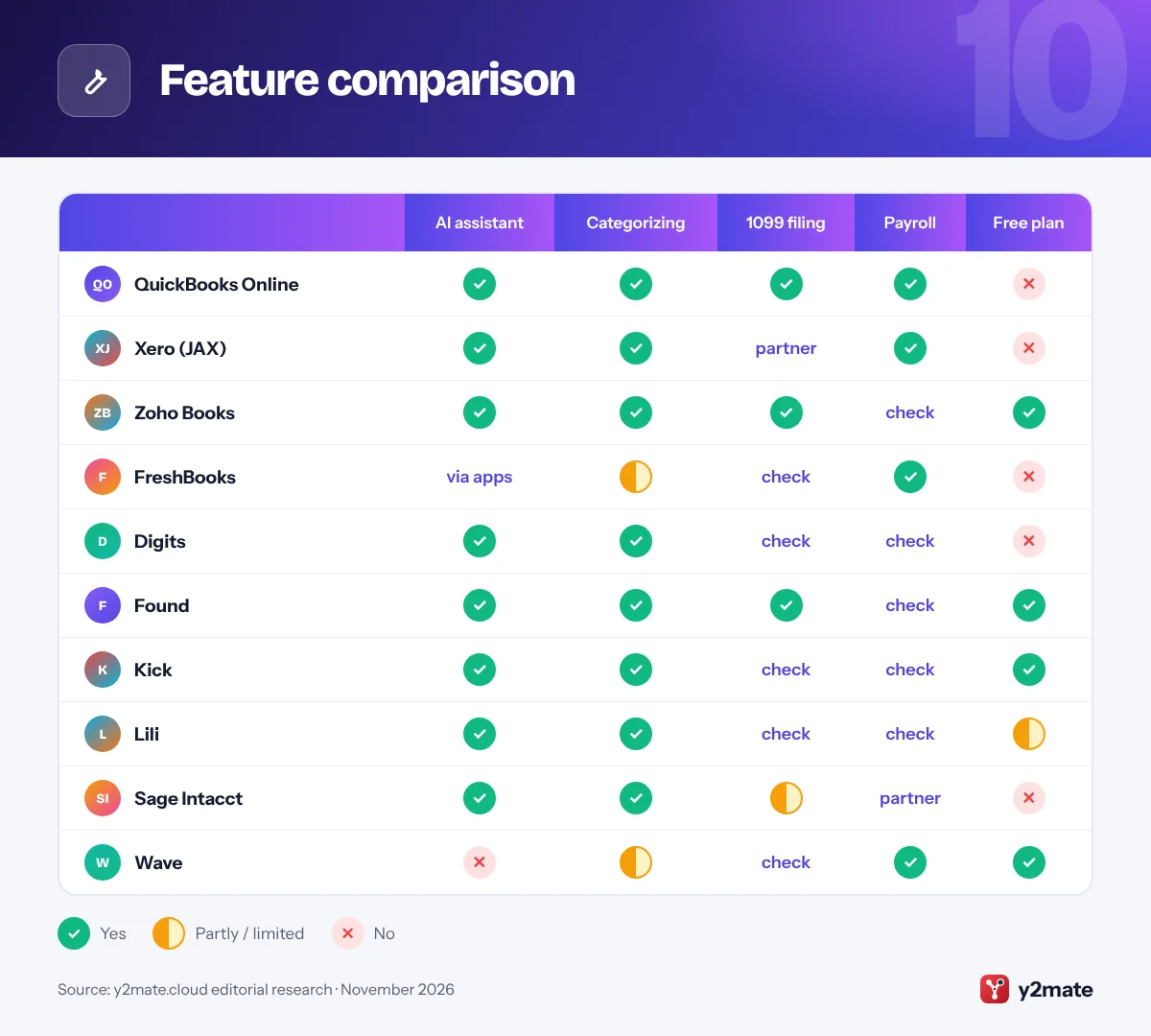
Feature comparison
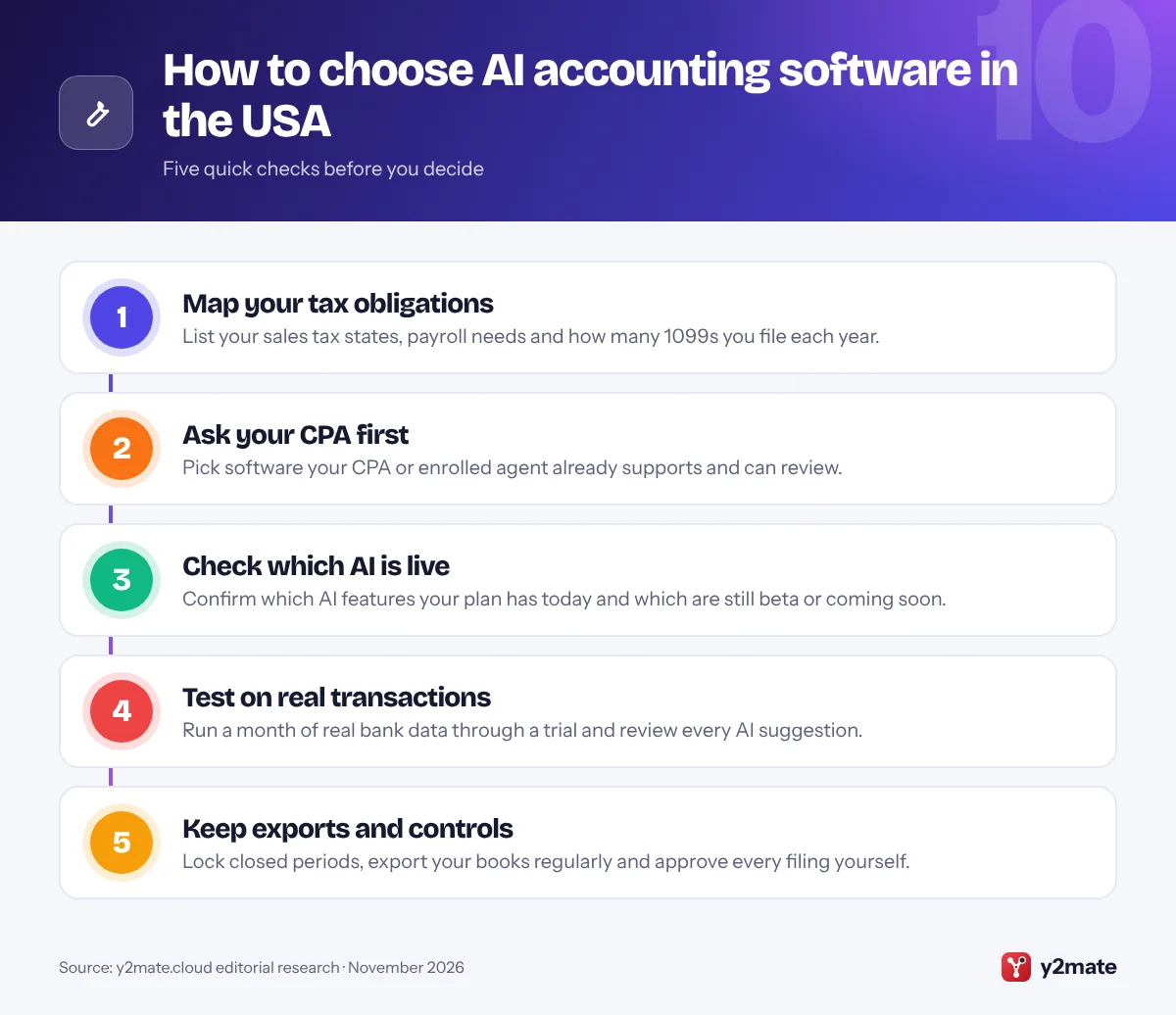
How to choose AI accounting software for a US small business
Start with compliance, not the chatbot. The most useful AI accounting software keeps your sales tax, payroll and information returns right first, then saves you time on categorizing and reconciling.
1099s now go through IRIS
The IRS stopped accepting information returns through its FIRE system after November 19, 2026, and from January 2027 electronic filing runs through IRIS. Small filers can use the free IRIS Taxpayer Portal, which handles up to 100 returns at a time, or file from software such as QuickBooks Online, Zoho Books or Found. If you file 10 or more information returns in total, you generally must e-file. For payments made after December 31, 2025, the threshold for reporting on Forms 1099-NEC and 1099-MISC is $2,000, up from $600.
Sales tax and payroll
If you sell taxable goods into several states, you need software that calculates rates by location, such as QuickBooks or Xero with Avalara, plus a clear process for filing in each state. Payroll should connect to your ledger so wages and payroll taxes post automatically.
Treat AI as a junior bookkeeper
- Review AI categorizations before you close each month.
- Lock closed periods so agents cannot change them.
- Keep a CPA or enrolled agent for returns and tax advice.
- Export your books regularly.
That matters: online bookkeeping service Bench shut down abruptly in December 2024 before Employer.com agreed to acquire it, and customers reported trouble getting their records out.
Frequently asked questions
What is the best AI accounting software for small businesses in the USA?
For most US small businesses, QuickBooks Online is the best all-round choice because its Intuit AI agents work alongside built-in sales tax, payroll and 1099 e-filing, and most accountants know it. Xero suits firms that want transparent automatic reconciliation, Zoho Books is the value pick, and freelancers may prefer simpler all-in-one apps such as Found or Lili.
Can AI accounting software file my 1099s?
Some can. QuickBooks Online, Zoho Books and Found can prepare and e-file Forms 1099-NEC and 1099-MISC, while Xero generates 1099 reports and files through partner apps. From January 2027, electronic information returns go to the IRS through IRIS, either from software or the free IRIS Taxpayer Portal. You still need correct W-9 details and should review each form before it is sent.
Does AI bookkeeping replace an accountant?
No. AI tools can categorize transactions, match bank feeds, read receipts and answer questions, but they make mistakes and do not take responsibility for your tax return. Providers such as Lili and Found state that their AI does not give tax advice. Use AI to keep the books current, then have a CPA or enrolled agent review year-end figures, payroll filings and anything unusual.
Is there free AI accounting software in the US?
There are free plans, but the AI features are usually limited. Zoho Books has a free plan for solopreneurs and micro businesses, Found's free plan includes bookkeeping and 1099 e-filing, Kick lets you start free and Wave's Starter plan is free, though Wave's automation needs the paid Pro plan. QuickBooks and Xero have no free plan.
What happened to Bench accounting?
Bench, a Vancouver-based online bookkeeping service popular with US small businesses, shut down abruptly in late December 2024. Days later, HR and payroll company Employer.com announced it would acquire Bench and restore customer access. The episode is a reminder to export your books regularly and to choose software where you control your own data, whichever AI accounting tool you use.
Final verdict
For most US small businesses, QuickBooks Online is the AI accounting software to beat in 2026: its agents cover categorization and sales tax, with payroll and 1099 e-filing in the same place. Choose Xero for reconciliation that explains itself, or Zoho Books if budget matters.
Freelancers should look at Found, Lili or FreshBooks, startups at Digits or Kick, and finance teams at Sage Intacct. Whatever you pick, review what the AI does, keep your CPA involved and use IRIS-ready software for the 2027 filing season.
Sources and further reading
- IRS guide to e-filing with IRIS: The IRS explains how to e-file Forms 1099 and other information returns through IRIS, including its free Taxpayer Portal.
- IRS FIRE to IRIS transition: An IRS news release with the key dates for retiring the FIRE system and moving information return filing to IRIS.
- IRS Form 1099-NEC FAQs: IRS answers on when businesses must file Form 1099-NEC, including the higher threshold for payments made after 2025.
- IRS Self-Employed Tax Center: IRS guidance for sole proprietors and freelancers on self-employment tax, estimated payments and record keeping.

Leave a Reply